The Macro Shift: The Great Re-Shoring. National security now depends on domestic production of critical minerals and semiconductors.
The Tactical Edge: Build for Scale. Prioritize manufacturing competence over pure software features to win government contracts.
The Bottom Line: The defense industrial base is being rebuilt from the ground up. The next decade belongs to the builders who can merge Silicon Valley speed with the Pentagon's scale.
The Macro Trend: Biological Sovereignty. As global systems destabilize, the Amazon remains the most critical piece of biological infrastructure on the planet.
The Tactical Edge: Support Jungle Keepers. Direct capital to organizations that convert loggers into rangers to secure land concessions.
The Amazon is a finite asset under active siege. Protecting it requires a blend of primitive survival skills and high-tech surveillance over the next 18 months.
The Macro Pivot: As generative AI masters simulation, the physical world becomes a high-fidelity playground for software.
The Tactical Edge: Invest in the "brain" layer rather than the "limb" layer. Software that can generalize across different hardware forms will capture the most value.
The next decade belongs to embodied AI that reasons in real time. If you are waiting for the hardware to look perfect before paying attention, you will miss the moment the software takes over the physical world.
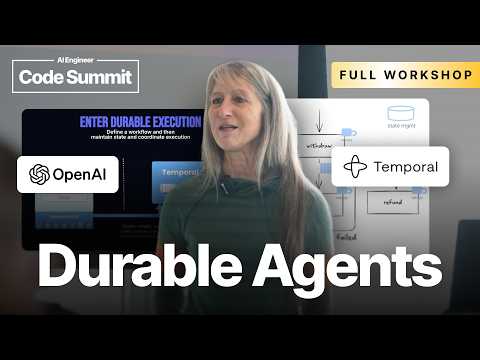
The industry is moving from "Agent as a Script" to "Agent as a Durable Service" where state management is handled by the infrastructure.
Wrap your existing API tools in the `activity_as_tool` function to gain automatic retries and execution history.
Reliability is the only moat in the agentic economy. If your agent cannot survive a server restart during a three-day task, it is not ready for the enterprise.
The Macro Trend: The move from fragmented content libraries to integrated health systems where AI synthesizes biomarkers and movement.
The Tactical Edge: Construct internal LLM tools to categorize qualitative feedback. This turns thousands of raw reviews into a precise roadmap.
The Bottom Line: Building a $100M ARR consumer app requires mastery of both growth loops and product retention. Solve for the daily habit to win the long game.
The transition from general-purpose AI to specialized application layers. As foundation models commoditize, value migrates to the "fat tail" of human-centric complexity.
Prioritize building or investing in "DNA of the future" companies that incumbents must eventually acquire to survive. Focus on winning the "point of attack" by staying deep in the technical details.
We are in a unique market where demand growth justifies high valuations. Success over the next year depends on identifying founders who are the absolute best in the world at one specific thing.
Strategic Implication: The shift in regulatory tone and corporate demand for privacy signals a maturation of the crypto industry. Solutions that balance privacy with accountability will capture significant market share.
Builder/Investor Note: Focus on projects building privacy-preserving compliance tools and "programmable risk management" frameworks. These are the infrastructure plays for mainstream adoption. Avoid projects that offer absolute privacy without any recourse mechanisms, as they face significant regulatory risk.
The "So What?": Over the next 6-12 months, expect increased innovation and investment in ZK-based privacy solutions that enable selective disclosure and verifiable compliance. This will be crucial for onboarding institutional capital and protecting individual users in a data-exposed world.
Integrated Finance is the Future: Robinhood's super app strategy, combining traditional and crypto assets, points to a future where financial services are consolidated and cross-pollinated.
Builders: Simplify, Simplify, Simplify: The path to mainstream crypto adoption requires abstracting away technical details. Focus on product utility, not underlying blockchain mechanics.
Tokenization's Long Game: Expect tokenization to redefine access to private markets and real-world assets, potentially disrupting traditional capital raising and ownership structures over the next 2-5 years.
Strategic Implication: The crypto industry is moving beyond speculative cycles, driven by the integration of real-world assets and the pursuit of tangible efficiencies by both startups and traditional financial giants.
Builder/Investor Note: Builders should prioritize utility and cost reduction for mainstream users, while investors must scrutinize projects for sustainable business models and genuine decentralization, rather than relying on hype or incentive schemes.
The "So What?": Regulatory clarity, particularly around DeFi and asset classification, will shape the next 6-12 months, determining which projects thrive by truly delivering value and which struggle under increased scrutiny.
Strategic Implication: Monad represents a significant bet on vertical scaling of Layer 1s, aiming to unlock a new class of high-performance DeFi applications by directly addressing core execution bottlenecks.
Builder/Investor Note: Full EVM bytecode compatibility means existing Ethereum dApps can migrate with minimal changes, immediately benefiting from 10,000+ TPS and 1-second finality. This opens doors for high-frequency DeFi, on-chain order books, and complex AI/ML applications.
The "So What?": If Monad delivers on its promises, it could validate a powerful alternative scaling path for crypto, shifting focus back to base-layer innovation and enabling decentralized finance to truly compete with centralized exchanges in performance and cost within the next 6-12 months.
Strategic Implication: The industry's future lies in seamless integration with the broader economy, making blockchain an invisible, value-adding layer for everyday products.
Builder/Investor Note: Focus on projects solving real problems, demonstrating product-market fit in proven sectors (stablecoins, perps, token issuance), and prioritizing user experience over maximalist decentralization.
The "So What?": The next 6-12 months will reward deep research and conviction in quality assets, as the market shifts from speculative narratives to tangible utility and real-world adoption.
Strategic Implication: The lines between traditional finance, crypto, and cultural markets will blur. "Internet markets" will encompass everything, driven by attention and mimetics.
Builder/Investor Note: Focus on platforms that facilitate permissionless market creation and enhance the "spectacle" of trading. User experience that feels as native as social media will capture Gen Z's capital.
The "So What?": Crypto's open, liquid, and attention-driven nature makes it the ultimate infrastructure for this new financial paradigm. The next decade will see an explosion of internet asset trading, with crypto at its core.