The Macro Shift: AI's compute demands are fundamentally re-prioritizing semiconductor production, shifting capacity from consumer-grade memory to high-margin, specialized AI components like HBM and NAND, creating a new economic reality for chipmakers and a supply crunch for everyone else.
The Tactical Edge: Invest in companies positioned to benefit from the sustained, multi-year capex cycle of hyperscalers, particularly those innovating in HBM, advanced NAND solutions, and optical interconnects, as these are the bottlenecks of tomorrow's AI infrastructure.
The Bottom Line: The AI infrastructure buildout is far from over, with hyperscalers projecting over $600 billion in 2026 capex. This sustained investment will continue to drive demand and innovation across the semiconductor supply chain, making memory and specialized compute the critical battlegrounds for the next 6-12 months.
AI's compute demands are fundamentally reordering semiconductor supply chains, shifting capacity and investment away from consumer markets towards high-margin, specialized AI hardware.
Investors should scrutinize hyperscaler capex allocations, identifying companies with clear, high-margin monetization paths for their AI investments, particularly those with vertical integration or strong enterprise reach.
The AI infrastructure buildout is far from over, with hyperscalers accelerating spend into 2027 and beyond. This sustained demand will continue to drive memory prices and reshape the competitive landscape for chipmakers and cloud providers.
The era of monolithic, general-purpose AI is giving way to a modular, personalized future where models act as intelligent orchestrators, retrieving and reasoning over vast, bespoke data sets with specialized hardware.
Invest in infrastructure and tooling that enables low-latency, multi-turn interactions with AI agents, and prioritize crisp, multimodal prompt engineering. This will be the new "specification" for delegating complex tasks.
The next 6-12 months will see a significant push towards hyper-personalized AI and ultra-low-latency inference, driven by hardware-software co-optimization and advanced distillation. Builders and investors should focus on solutions that leverage these trends to unlock new applications and user experiences.
The software development paradigm is shifting from human-centric coding to agent-centric building. This means optimizing codebases for AI agents to navigate and modify, making "building" (problem definition, architecture, agent guidance) more valuable than manual implementation.
Prioritize "agent-friendly" design. Builders should focus on creating modular, CLI-accessible tools and services that agents can easily discover, understand, and compose, rather than monolithic applications. Investors should seek out platforms and infrastructure that facilitate this agent-native ecosystem.
Personal AI agents with system-level access are not just a new tool; they are a new operating system. This will redefine personal productivity, disrupt the app economy, and necessitate a re-evaluation of digital security and human-AI collaboration over the next 6-12 months.
The rise of autonomous AI agents with system-level access is fundamentally changing the human-computer interface. This isn't just about better tools; it's about a new model where agents become the operating system, coordinating tasks across applications and data, making traditional app-centric workflows increasingly inefficient and potentially obsolete.
Prioritize learning "agentic engineering" – the art of guiding and collaborating with AI agents rather than direct coding. This involves understanding agent perspectives, crafting concise prompts, and utilizing CLI-based tools for composability, which will be crucial for building and adapting in an agent-first world.
Over the next 6-12 months, the ability to effectively deploy and manage personal AI agents will become a core competency for builders and a critical differentiator for businesses. Ignoring this change risks being left behind as AI agents redefine productivity, security, and the very structure of digital interaction.
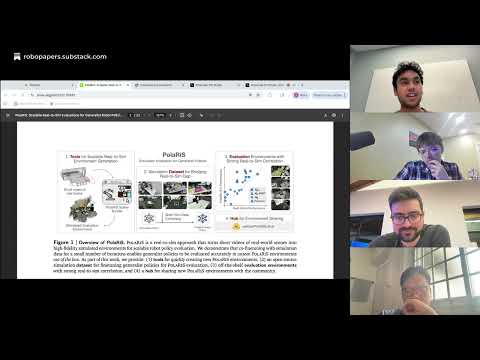
The Macro Shift: Generalist robot policies, like large language models, demand evaluation that tests true generalization, not just performance on known training data. PolaRiS enables this shift by providing a scalable, community-driven framework for creating diverse, unseen test environments, pushing robotics beyond task-specific benchmarks.
The Tactical Edge: Builders should leverage PolaRiS's real-to-sim environment generation (Gaussian splatting, generative objects) and co-training methodology to rapidly iterate on robot policies. This allows for quick, correlated performance checks in diverse virtual settings before costly real-world deployment.
The Bottom Line: The future of robotics hinges on models that generalize. PolaRiS offers the infrastructure to build and test these models efficiently, fostering a community-driven benchmark ecosystem that will accelerate robot capabilities and deployment over the next 6-12 months.
The AI domain is moving from passive, prompt-response models to active, autonomous agents capable of self-modification and system-level action. This fundamentally alters software development, making "agentic engineering" the new model where human builders guide AI to create and maintain code, democratizing access to building while challenging the traditional app economy.
Prioritize building agent-friendly APIs and CLI tools for your services, or integrate existing ones, to ensure your offerings remain relevant in a world where personal AI agents act as the primary interface for users.
Personal AI agents are poised to become the operating system of the future, absorbing functionalities of countless apps. Builders and investors must adapt to this change, focusing on foundational agent infrastructure, security, and the human-agent collaboration model, or risk being disrupted by this new era of autonomous computing.
The rise of generalist robot policies demands scalable, generalizable evaluation. PolaRiS enables this by shifting from costly real-world or handcrafted sim evals to cheap, high-fidelity, real-to-sim environments, accelerating policy iteration and fostering community-driven benchmarking.
Builders should explore PolaRiS's open-source tools and Hugging Face hub to rapidly create and test new robot tasks. This allows for faster policy iteration and robust comparison against diverse, community-contributed benchmarks, moving beyond static, overfitting evaluation suites.
The ability to quickly and reliably evaluate robot policies in diverse, real-world-correlated simulations will be a critical bottleneck for robotics progress. PolaRiS offers a path to unlock faster development cycles and broader generalization for robot AI, making it a key infrastructure piece for the next wave of robotic capabilities.
The automotive industry is undergoing a fundamental re-architecture, moving from a fragmented, supplier-dependent model to a vertically integrated, software-defined, AI-first paradigm.
Investors should prioritize companies demonstrating deep vertical integration in AI hardware and software, a robust data acquisition strategy (large car park), and a clear vision for expanding EV choice beyond current market leaders.
Autonomy will be a non-negotiable feature in cars by 2030, making a company's ability to build and iterate AI models in-house the ultimate differentiator.
Strategic Implication: Bittensor's unique decentralized AI model, coupled with Bitcoin-like scarcity and a self-marketing subnet, sets it apart as a foundational AI infrastructure play.
Builder/Investor Note: The $TAO halving creates a significant supply shock. Builders should observe Bitcast's "one-click mining" and AI-powered automation as a blueprint for efficient decentralized applications.
The So What?: The convergence of reduced supply and increased marketing via Bitcast could drive substantial demand for $TAO over the next 6-12 months, making it a critical asset for those tracking the AI and crypto intersection.
Strategic Implication: The "crypto fund" label will fade. Investors and builders must specialize in specific verticals (fintech, gaming, etc.) that happen to use blockchain, rather than just "crypto."
Builder/Investor Note: Prioritize applications that abstract away crypto for the end-user. For investors, scrutinize projects for clear, sustainable monetization strategies beyond tokenomics.
The "So What?": Over the next 6-12 months, the market will reward projects that successfully bridge the gap to non-crypto users, demonstrating real-world utility and robust business models. Those clinging to cryptonative-only strategies risk irrelevance.
Strategic Implication: The crypto industry will bifurcate: a speculative, crypto-native segment and a mass-market, application-driven segment. The latter will attract traditional tech and finance, blurring the lines of "crypto" investing.
Builder/Investor Note: Builders must prioritize user experience for non-crypto users. Investors should favor projects with clear revenue models and aligned DAO/Labs incentives.
The So What?: The next 6-12 months will see increased competition from traditional tech, forcing crypto projects to either adapt to mainstream user needs and sustainable business models or risk irrelevance outside their niche.
Strategic Implication: Bittensor's halving, combined with Bitcast's decentralized marketing, could propel $TAO into a growth trajectory reminiscent of Bitcoin's early post-halving cycles.
Builder/Investor Note: Investors should consider $TAO's potential as a long-term hold, monitoring Bitcast's creator onboarding and campaign volume. Builders can explore creating subnets to address ecosystem needs, leveraging AI for automation.
The "So What?": The next 6-12 months will test if Bittensor can translate its unique tokenomics and subnet innovation into significant market adoption and value, potentially establishing itself as a foundational layer for decentralized AI.