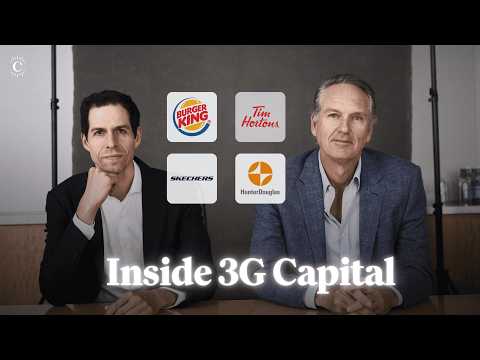
3G commits to one investment per fund, deploying significant internal capital alongside partners. This focus allows for rigorous downside analysis and patience, ensuring only truly exceptional businesses are acquired.
3G partners are seasoned operators who step into businesses, aligning incentives with ownership. This hands-on approach ensures decisions serve the business's long-term health, not just short-term management goals.
3G prioritizes businesses that directly own their customer relationships, like Burger King or Hunter Douglas. This direct connection reduces disintermediation risk from retailers or new technologies.
As capital markets become increasingly efficient and competitive, the edge moves from financial engineering to deep operational expertise and long-term, owner-aligned management.
Prioritize identifying and enabling high-potential individuals early in their careers, granting them significant responsibility and ownership.
Disciplined focus, patient relationship building, and an unwavering commitment to operational excellence in established, defensible businesses can still yield generational wealth.
The Macro Trend: In a world obsessed with digital disruption, 3G Capital's success with "atoms over bits" businesses highlights a strategic pivot: enduring value often resides in established brands with proprietary customer relationships, where operational excellence and long-term thinking create moats against fleeting tech trends.
The Tactical Edge: Identify businesses with strong, direct customer relationships and a clear path for operational improvement, even if they appear "boring." Prioritize deep, hands-on involvement to drive value, rather than relying solely on financial engineering.
The Bottom Line: The future of outsized returns may not be in chasing the next big tech wave, but in patiently acquiring and meticulously operating businesses that own their customer relationships, leveraging technology to enhance, not redefine, their core value. This strategy offers a more predictable, less volatile path to compounding capital.
The Macro Shift: In a world obsessed with digital disruption, 3G Capital's success highlights the enduring power of "hard" businesses with strong customer relationships. Their focus on foundational consumer brands, managed by operator-investors who prioritize long-term ownership and disciplined execution, offers a robust counter-narrative to the "bits over atoms" trend.
The Tactical Edge: Cultivate an extreme ownership culture by aligning incentives deeply, empowering young talent with real responsibility, and fostering a relentless bias for action.
The Bottom Line: For investors and builders, the lesson is clear: patience, deep operational involvement, and a fanatical focus on talent in defensible, "boring" businesses can yield extraordinary, long-term value, even in expensive markets.
Extreme Focus: 3G Capital commits to one investment per fund, deploying significant internal capital alongside partners. This singular focus forces rigorous downside analysis and patience, ensuring they only pursue truly exceptional opportunities.
Owner Operators: 3G partners are seasoned operators who step into businesses, aligning incentives with ownership. This means leaders act like shareholders, making decisions for the business's long-term health, not just short-term management goals.
Disruption Defense: 3G prioritizes businesses with strong customer relationships and physical components, making them less susceptible to digital disintermediation. They seek enduring brands like Hunter Douglas, where the sun will always rise and set, ensuring a consistent need for their product.
In an era of rapid technological change, businesses with strong, direct customer relationships and physical moats are increasingly valuable. 3G's focus on these "atoms" businesses, enhanced by strategic tech adoption, provides a blueprint for durable value creation.
Cultivate an ownership culture by aligning incentives deeply, empowering young talent with real responsibility, and prioritizing long-term value over short-term gains.
The future belongs to patient, operator-led investors who can identify and transform enduring businesses by focusing on fundamental quality, people, and strategic technological integration, rather than chasing fleeting trends.
3G Capital's model counters this by doubling down on "atoms" businesses with strong customer relationships and defensible positions, then applying rigorous operational excellence.
Cultivate an owner-operator mindset within your organization, even if you are not a private equity firm. Identify and back high-potential young talent with significant responsibility and aligned incentives, providing mentorship to maximize their success.
In a world obsessed with speed and diversification, 3G Capital proves that deep, patient, operator-led concentration on high-quality, defensible businesses, combined with a culture of ownership and meritocracy, remains a powerful engine for outsized value creation.
The era of celebrity endorsements is evolving into one of celebrity ownership, driven by a growing understanding of equity's compounding power and enabled by new technologies that lower the barrier to business creation.
Prioritize building a diverse, expert team and actively seek out "boring" businesses or underserved markets with clear, unmet demand.
The next 6-12 months will see an acceleration of talent leveraging their brand for equity stakes, particularly in tech-enabled ventures. Position yourself to either participate in these deals or build the tools that empower this new class of owner-operators.
The transition from utilization-based pools to intent-based matching engines is the next evolution of DeFi. This movement mirrors the move from AMMs to order books in spot trading.
Monitor the rollout of Kamino’s fixed-rate products to lock in borrowing costs for geared positions. This move protects against the volatility of variable rate markets during high-activity periods.
Kamino is positioning itself as the back-end for the next generation of fintech. If they successfully bridge off-chain collateral, the protocol moves from a crypto-native tool to a global financial utility.
The Macro Shift: Liquidity is returning as the Treasury General Account drains, but capital is becoming more selective. The "rising tide" no longer lifts all boats; it only lifts those with clear value capture.
The Tactical Edge: Prioritize protocols with intrinsic cash flow or those partnering with legacy giants like FIS. Move away from "lottery ticket" tokens that lack a clear revenue mechanism.
The Bottom Line: 2026 will be the year of the "Quality Filter." Investors who survive the current wash-out will find value in the consolidation of the super apps and the institutionalization of on-chain credit.
The transition from Crypto as a Cult to Crypto as a Rail means the next winners will look like boring fintech giants rather than flashy token launches.
Focus on infrastructure projects solving for fast finality and interoperability. These are the toll booths for the coming wave of corporate tokenization.
The next 12 months will be defined by the Corpo Chain explosion. If you are not building for speed and performance, you are building for a niche that is shrinking.