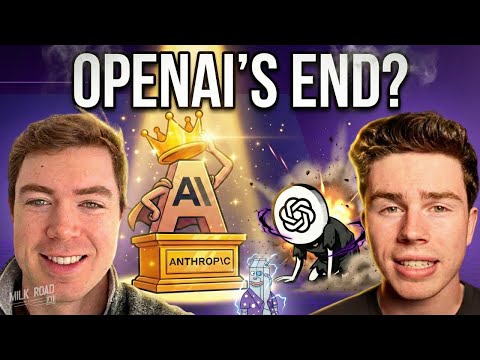
Trillion-dollar AI compute investments create market divergence: immediate monetization (Meta) is rewarded, while slower conversion (Microsoft) faces skepticism, as geopolitical tensions rise over open-source model parity.
Prioritize AI models balancing raw intelligence with superior user experience and collaborative features, as developer loyalty and enterprise adoption increasingly hinge on usability.
The AI landscape is rapidly reordering. Investors and builders must assess monetization pathways, geopolitical implications, and AI's social contract over the next 6-12 months.
The Macro Trend: The transition from opaque scaling to verifiable reasoning.
The Tactical Edge: Audit your models for brittleness by testing them on edge cases that require first principles logic rather than historical data.
The Bottom Line: The next winners in AI will not have the biggest models but the most verifiable ones. If you cannot prove how a model reached a conclusion, you cannot trust it in production.
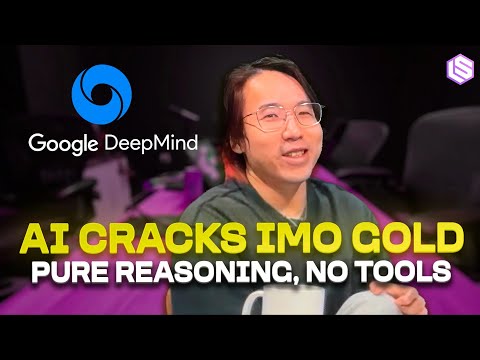
The transition from more data to better thinking via inference-time compute. Reasoning is becoming a post-training capability rather than a pre-training byproduct.
Use AI for anti-gravity coding to automate bug fixes and data visualization. Treat the model as a passive aura that buffs the productivity of every senior engineer.
AGI will not be a collection of narrow tools but a single model that reasons its way through any domain. The gap between closed labs and open source is widening as these reasoning tricks compound.
The transition from static LLMs to interactive world models marks the move from AI as a tool to AI as a persistent environment.
Monitor the Hugging Face release of the 2B model to build custom image-to-experience wrappers for niche training or spatial entertainment.
Local world models will become the primary interface for spatial computing within the next year, making high-end local compute more valuable than cloud-based streaming.
The Strategic Pivot: The transition from "Understanding-First" science to "Prediction-First" engineering. We are building artifacts that work perfectly but remain theoretically opaque.
The Tactical Edge: Audit your AI stack for "Leaky Abstractions." Don't assume a model's reasoning capabilities in one domain will hold when the underlying causal structure changes.
AGI isn't just an engineering milestone; it's a philosophical wager. If the brain isn't a computer, we are building a very powerful helicopter, not a synthetic human.
The pivot from "Understanding-First" science to "Prediction-First" engineering creates massive technical liability in our models.
Audit your AI implementations for "Leaky Abstractions" where the model fails to account for physical edge cases.
High-performance automation is not the same as sentient reasoning. Builders who recognize this distinction will avoid the cultural illusion of inevitable AGI.
The transition from deterministic software to agentic networks. Companies are moving from rigid workflows to fluid systems that plan and execute autonomously.
Build an internal LLM gateway early. Centralizing model routing and cost monitoring allows you to swap providers as the model horse race changes without refactoring your product.
AI is not just a feature but a fundamental restructuring of the corporate cost center. Efficiency gains allow a static headcount of 300 engineers to support a business growing 5x.
The Macro Shift: Deregulation is the new meta-theme. As the "Empire Strikes Back," traditional giants like Visa and Stripe will integrate crypto rails and turn the tech into invisible "TCP/IP" for finance.
The Tactical Edge: Monitor M&A activity during holiday periods. Look for "quality supply" consolidation where winners absorb the IP of failing projects.
The Bottom Line: 2026 is the target for a high-quality rally. The current shakeout is a feature designed to filter out the "nonsense supply" before the $40 trillion RIA channel arrives.
The Human Layer Exploit. As code becomes more robust, the attack surface moves to the people managing it. Security is now an HR and psychology problem as much as a technical one.
Deploy YubiKeys. Replace SMS and app-based 2FA with hardware keys to stop phishing. If a site cannot talk to your physical key, the attacker cannot steal your session.
Security is a process of adding layers, not a one-time audit. If you do not have a "blast radius" strategy to isolate your funds, you are one bad click away from a total loss.
The Macro Evolution: The Institutional Osmosis. Crypto is no longer a parallel universe but a high-speed rail for traditional assets.
The Tactical Edge: Audit Your Humans. Implement "Camera-On" policies and cross-verify identities via physical meetups to neutralize remote infiltration.
The Bottom Line: Survival in the next 12 months depends on moving from "Degen" security to "Enterprise" resilience as the lines between Coinbase and BlackRock vanish.
The Macro Shift: Content Abundance vs. Attention Scarcity. As AI makes the "what" of gaming cheap, the "where" (distribution) and "who" (high-LTV users) become the only defensible assets.
The Tactical Edge: Skin the Game. Use AI to rapidly iterate on visual assets for existing mechanics to capture trending subcultures within crypto communities.
The Bottom Line: The future of gaming isn't about building a 10-year world; it's about building high-fidelity, ephemeral experiences that drive value to on-chain ecosystems.
The Macro Shift: Macro gravity is currently winning as high interest rates suppress risk-on assets while AI captures the remaining speculative energy.
The Tactical Edge: Accumulate Ethereum only when it enters the regression band and Bitcoin when it touches the 200-week moving average.
The Bottom Line: The next major opportunity likely arrives in the summer of 2026 when monetary policy finally turns accommodative and the labor market stabilizes.