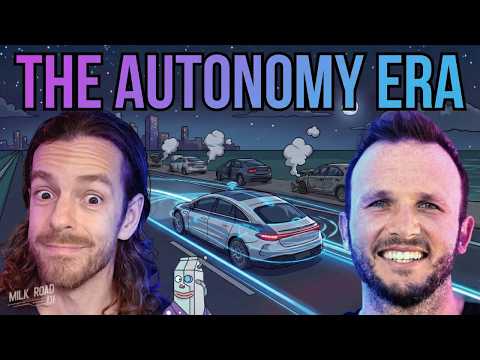
AI-driven automation is collapsing the cost of transportation and labor, creating a deflationary force that will reshape global economies and supply chains.
Investors should evaluate companies based on their AI moat and vertical integration, recognizing that traditional industry classifications no longer apply to leaders like Tesla.
Tesla's imminent unsupervised FSD rollout and robo-taxi network will unlock massive, new revenue streams, potentially 10x-ing current revenues by 2030, making its current valuation a bargain for those who understand the AI-first vision.
The global economy is transitioning to an AI-driven, deflationary model, where vertically integrated autonomous systems will drastically reduce the cost of labor and transportation. Tesla's unique data moat and full-stack approach position it as a primary beneficiary and driver of this shift.
Investors should re-evaluate Tesla not as an automotive stock, but as a dominant AI and robotics platform with multiple, compounding revenue streams. Consider its long-term potential beyond current market perceptions, especially as unsupervised FSD and humanoid robots scale.
Tesla's strategic pivot and technological lead in autonomous AI are set to unlock unprecedented value in the coming years. Its ability to generate passive income for car owners and its expansion into humanoid robotics and space-based data processing will fundamentally reshape industries and investment landscapes.
AI driven abundance is set to redefine global economics. Tesla's vertically integrated approach to autonomous systems (FSD, robo taxis, humanoid robots) and its unique data moat will drive massive deflation across transportation and labor, fundamentally altering cost structures and consumer behavior.
Invest in infrastructure plays that support massive AI compute and data processing, or directly in companies with unassailable data moats in autonomous systems. Consider Tesla as a long term AI bet, not just an EV play, especially on dips, recognizing its unique position to generate recurring revenue from FSD subscriptions and robo taxi networks.
Tesla's transition from car manufacturer to AI and robotics platform, underpinned by its FSD dominance and the convergence of Musk's ventures, positions it to capture multi trillion dollar markets. This shift will create unprecedented opportunities for investors who understand the underlying technological and economic forces at play over the next 6-12 months.
Tesla's core identity is an AI company, not an EV maker. Its competitive advantage stems from its neural network approach to FSD.
A Tesla owner can soon deploy their car as a robo-taxi, potentially earning $60-80k+ annually. This transforms a depreciating asset into a cash-generating machine, altering car ownership economics.
Tesla's ability to build cars entirely in-house, coupled with its AI data collection and processing, gives it a unique advantage. This allows faster innovation and cost control.
AI-driven automation, spearheaded by Tesla's FSD and robotics, is poised to create a deflationary environment for transportation and labor. This will fundamentally alter consumer spending and corporate cost structures.
Evaluate Tesla's stock not as an automotive company, but as a dominant AI and robotics platform with multiple, compounding revenue streams. Consider long-term positions, especially on dips, as the market reprices its future potential.
Tesla's unique, vertically integrated approach to AI and robotics, combined with Elon Musk's multi-planetary vision, positions it to capture and reshape multiple trillion-dollar industries. Understanding this fundamental shift is crucial for anyone building or investing in the future of automation over the next 6-12 months.
Evaluate Tesla not as an automotive stock, but as a dominant AI and robotics platform with a clear path to exponential revenue growth from FSD and humanoid robots. Consider long-term investment, especially during market pullbacks.
The convergence of AI, robotics, and space infrastructure, spearheaded by Elon Musk's companies, is creating a new economic paradigm of abundance and deflation. This trend will fundamentally alter labor markets and consumer spending.
Tesla's reorientation to an autonomous robotics and AI company, powered by FSD and integrated with SpaceX and XAI, is set to create unprecedented value. Investors and builders must understand this pivot for the next wave of technological and economic change.
AI-driven automation is creating a new economic reality where vertically integrated AI companies will dominate core industries like transportation and labor, leading to massive deflationary pressures and a re-evaluation of asset value.
Investors should recognize Tesla's FSD and robotics as its primary value drivers, not its EV sales. Focus on its unique data moat and the impending regulatory approvals for unsupervised FSD as key catalysts for a significant market repricing.
Tesla is poised to become a multi-trillion-dollar company by owning the future of autonomous transportation and labor. Understanding this shift is crucial for positioning your portfolio for the next wave of AI-driven wealth creation over the next 6-12 months.
Tesla's core identity has shifted from an EV manufacturer to an AI and autonomous robotics company. This means its competitive advantage isn't in car sales, but in its proprietary neural network and data processing capabilities for self-driving.
Tesla's upcoming robo-taxi network will compete directly with ride-sharing services, not traditional car manufacturers. This means a 10x cheaper service, potentially making car ownership obsolete for many.
Elon Musk's early bet on neural networks over LiDAR for FSD gave Tesla a multi-year lead. This foresight allowed Tesla to build a data moat that competitors cannot replicate quickly.
The AI infrastructure buildout is moving from speculative intuition to financially engineered certainty, driven by the need to de-risk massive capital investments in volatile hardware markets.
Evaluate your compute procurement and data center buildout strategies through the lens of financial hedging instruments to secure predictable costs and unlock cheaper capital.
Financial products for compute are not just a nice-to-have; they are becoming essential for sustainable growth in AI infrastructure, directly impacting profitability and investment viability over the next 6-12 months.
The Macro Strategic Pivot: Vertical Consolidation. Protocols are moving away from modularity toward integrated stacks to capture maximum fee revenue.
The Tactical Edge: Monitor BLP Rates. Watch the spread between Felix and Hyperliquid’s native lending rates. Capital will migrate to the platform offering the lowest borrow cost for margin trading.
The Bottom Line: Hyperliquid is winning by becoming a DeFi Super App rather than just a perp engine. Its success over the next year depends on its ability to manage UI fragmentation while keeping all revenue inside the Hype ecosystem.
The Macro Trend: The transition from fragmented L2 liquidity to unified cross-chain execution.
The Tactical Edge: Monitor Arrow’s Q2 launch on Mainnet to capitalize on the initial liquidity migration.
The Bottom Line: Arrow is building the operating system for Ethereum liquidity. If they capture even a fraction of Mainnet the economic model moves from inflationary to net-positive.