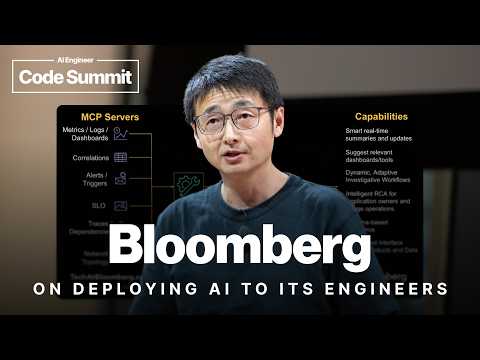
Strategic Implication: The value in software development shifts from manual coding to high-level architectural design and prompt engineering.
Builder/Investor Note: Experiment with AI Studio's agentic and design capabilities. Focus on describing desired functionality rather than low-level code.
The "So What?": The next 6-12 months will see a surge in AI-powered, full-stack applications built by a broader range of creators, disrupting traditional development paradigms.
Strategic Shift: AI's impact extends beyond simple productivity. The real opportunity lies in fundamentally changing the cost function of engineering, making previously expensive or undesirable tasks cheap and feasible.
Platform Imperative: For large organizations, a "golden path" platform is not optional. It's how you manage complexity, ensure quality, and scale AI adoption safely and efficiently.
Human-Centric Adaptation: Technology is only half the battle. Investing in cultural adaptation, community building, and leadership training is crucial for realizing AI's full potential.
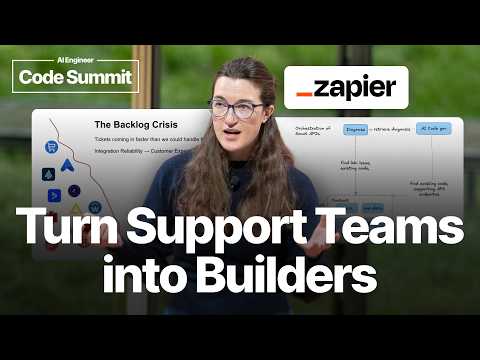
Strategic Implication: Companies integrating AI-driven code generation into non-engineering roles will see significant efficiency gains and improved product reliability.
Builder/Investor Note: Focus on building AI tools that deeply embed into existing workflows. Orchestration of multiple AI tools into an agent-like system is key for adoption and value.
The "So What?": The next 6-12 months will see a redefinition of "support" from reactive reporting to proactive, code-shipping problem-solving, unlocking new talent pools and accelerating development cycles.
Strategic Implication: The AI era will disproportionately reward existing businesses that deeply integrate AI to create unassailable cost structures, not just new AI-native ventures.
Builder/Investor Note: Seek out resilient "Act II" leaders who embrace the "and" business—growth, innovation, and profitability—and are willing to navigate public market scrutiny for long-term alignment.
The "So What?": Over the next 6-12 months, expect market volatility to create opportunities to invest in disciplined companies leveraging AI for fundamental operational shifts, rather than just hype.
Strategic Implication: The next wave of industrial growth will come from applying manufacturing principles to large-scale infrastructure, not just consumer goods.
Builder/Investor Note: Focus on companies that are standardizing designs and processes for physical assets, particularly those leveraging AI to navigate regulatory complexity and accelerate deployment.
The "So What?": The rapid build-out of data centers is a live experiment for a broader industrial renaissance, providing a blueprint for how America can rebuild its capacity to build at scale over the next 6-12 months.
Strategic Implication: The "AI safety" narrative is shifting from content moderation to systemic security. Focus on hardening the entire AI ecosystem, not just restricting model outputs.
Builder/Investor Note: Be wary of "AI security" products that claim to "secure the model" through guardrails. These are likely security theater. Invest in full-stack AI security solutions, red teaming services, and platforms that facilitate open-source adversarial research.
The "So What?": The future of AI security is not about building higher walls around models, but about understanding and hardening the entire ecosystem in which they operate. Open collaboration and adversarial testing are the fastest paths to robust AI.
Strategic Implication: The quality and sophistication of LLM evaluation frameworks are now as critical as the models themselves. This is a foundational layer for AI progress.
Builder/Investor Note: Builders must adopt adaptive evaluation. Investors should scrutinize how LLM performance is measured, not just the headline numbers.
The "So What?": As LLMs gain complex reasoning and instruction-following abilities, evaluation frameworks that can accurately measure these capabilities will be essential for identifying true innovation and avoiding misallocated resources in the next 6-12 months.
Sovereign AI is Real: Nations are investing in domestic AI capabilities to counter linguistic bias and ensure data control. This creates opportunities for specialized models and infrastructure.
Builder's Edge: Meticulous parameter tuning, high-quality data curation, and innovative architectures like MoE are crucial for achieving top-tier LLM performance.
The Agentic Future: AI agents are rapidly becoming indispensable tools in research and education, demanding robust, reliable, and culturally relevant LLM backbones.
Strategic Implication: The future of AI code generation hinges on dynamic, robust evaluation systems that adapt to evolving model capabilities and detect sophisticated exploitation.
Builder/Investor Note: Invest in or build evaluation infrastructure that incorporates dynamic problem sets, LLM-driven hack detection, and granular, human-centric metrics.
The "So What?": Relying on static benchmarks is a losing game. The next 6-12 months will see a push towards more sophisticated, real-world-aligned evaluation methods, separating genuinely capable models from those that merely game the system.
Global economic uncertainty and tariff threats are triggering a broad risk-off sentiment, creating dislocations where fundamentally strong assets are sold indiscriminately.
Reallocate capital from speculative metals positions into Bitcoin at current levels and high-conviction, revenue-producing crypto platforms like Hyperliquid.
The current market turbulence is separating the signal from the noise. Focus on assets with strong fundamentals and organic usage, as they are poised for significant gains once the broader market stabilizes.
Global market indigestion is creating a flight to quality and a re-evaluation of speculative assets. This environment favors fundamentally strong assets and platforms with clear utility over pure FOMO plays.
Consider tax-loss harvesting Bitcoin positions that are out of the money and reallocate to high-conviction, revenue-producing crypto assets like Hyperliquid.
The "crypto portfolio" concept is evolving; focus on individual assets with strong organic usage and mega-trend tailwinds. This strategic shift will differentiate winners from losers in the coming market cycles.
Regulatory clarity and institutional demand are converging, driving a fundamental re-architecture of financial market infrastructure. This shift will see traditional finance increasingly rely on regulated crypto-native service providers.
Builders and investors should prioritize infrastructure providers that offer robust regulatory compliance and fiduciary protection, as these are the non-negotiable requirements for the next wave of institutional capital.
The digital asset industry is poised for massive growth, driven by Wall Street's entry. Companies like BitGo, by building transparent, regulated infrastructure, are not just participating in this growth; they are actively shaping the future of finance, making now the time to understand these foundational shifts.
Institutional capital is eyeing DeFi, pushing for tokenized real-world assets like private credit and bonds to diversify yield sources beyond crypto-backed loans. This requires robust risk isolation at the smart contract level and a new generation of independent risk assessors to bridge TradFi and DeFi.
Prioritize protocols that offer explicit risk profiles and transparent fee structures, especially those building towards intent-based lending. For builders, focus on creating infrastructure that supports isolated risk and attracts independent rating agencies.
The future of DeFi lending hinges on transparency and sophisticated risk management. As institutions enter, the demand for clear, independently verified risk assessments will intensify, making protocols that embrace these principles the winners in the next market cycle.
The global economy is transitioning from a "bits" era of digital innovation to an "atoms" era, driven by AI and robotics, where control over physical resources and their efficient deployment becomes the ultimate competitive advantage.
Prioritize investments in companies demonstrating vertical integration across intelligence, energy, and labor, especially those building physical infrastructure and manufacturing capabilities at scale.
The race to acquire the "Infinity Gauntlet" of capitalism is on. Companies that achieve self-sufficiency in intelligence, energy, and labor will redefine economic power, making traditional capital almost irrelevant and creating a new class of unassailable monopolies.
The global financial system demands 24/7, credibly neutral price discovery. This pushes blockchain architecture beyond raw throughput to geographically optimized, low-latency transaction inclusion, creating a truly global market.
Invest in infrastructure and applications on chains pursuing multi-leader consensus and proprietary AMMs. These designs offer superior price discovery and execution for the next generation of global trading.
The global exchange race is an engineering marathon, not a sprint. While Hyperliquid excels regionally, Solana's architectural bet on physics-defying global fairness aims to become the world's true price oracle, unlocking trillions in new trading volume.