The Macro Shift: Celebrity capital is moving from transactional endorsements to strategic equity investments, driven by a desire for long-term wealth creation and the recognition that personal brand power can significantly accelerate startup growth.
The Tactical Edge: Cultivate a diverse network of mentors and partners, prioritizing those who bring complementary expertise and can challenge your assumptions.
The Bottom Line: The future of wealth creation for high-profile individuals and savvy investors lies in strategic, long-term equity plays, supported by strong teams and a willingness to partner.
AI agents with system-level access are shifting the core value proposition of software from discrete applications to fluid, context-aware personal assistants.
Cultivate "agent empathy" by learning to guide AI models effectively, understanding their limitations, and designing projects for agent-first navigation.
The rise of autonomous agents will redefine software's purpose and value.
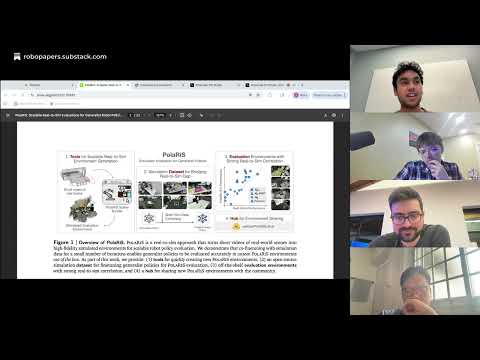
Adopt PolaRiS for rapid policy iteration. Leverage its real-to-sim environment generation and minimal sim data co-training to quickly validate robot policies in diverse, unseen environments before committing to expensive real-world deployments.
The era of generalist robot policies demands a new paradigm for evaluation. The shift is from bespoke, real-world testing to scalable, high-fidelity sim-to-real correlation, enabling faster iteration and broader generalization testing.
Reliable sim-to-real evaluation is the missing link for accelerating robot AI. PolaRiS offers a pragmatic, community-driven path to unlock faster development cycles and more robust generalist robot policies over the next 6-12 months.
Generalist robot policies demand evaluation that tests true generalization across diverse, unseen environments. The shift is from hand-tuned, task-specific benchmarks to scalable, community-driven evaluation suites that can keep pace with rapidly improving model capabilities. This requires tools that make environment creation cheap and ensure real-world predictive power.
Adopt PolaRiS for rapid, correlated policy iteration. Builders should leverage its real-to-sim environment generation (Gaussian splatting for scenes, generative models for objects) and the "sim co-training" trick to quickly validate policy improvements against real-world performance, especially for pick-and-place tasks. Contribute new environments to the Polaris Hub to expand the collective benchmark.
The future of robotics hinges on fast, reliable evaluation. PolaRiS offers a pragmatic, immediate solution to accelerate policy development by providing high-fidelity, correlated sim environments. Over the next 6-12 months, expect this hybrid approach to become a standard for iterating on generalist robot policies, while fully learned world models continue to improve for more complex, deformable tasks.
The push for generalist robot policies demands scalable, trustworthy evaluation. PolaRiS democratizes high-fidelity sim evaluation, moving robotics closer to rapid iteration cycles seen in other AI fields.
Builders should explore PolaRiS's open-source tools and pre-trained checkpoints to quickly test policies in diverse, real-world-correlated environments. Prioritize visual fidelity and use small, unrelated sim data for alignment.
Rapid, reliable sim evaluation with strong real-world correlation is a significant advancement. This tool enables faster policy iteration, broader generalization, and community-driven benchmarking, setting the stage for the next generation of robot capabilities.
Generalist robot policies demand community-driven, scalable evaluation, mirroring LLM benchmarking. PolaRiS provides the technical foundation by making high-fidelity, correlated sim environments accessible.
Adopt PolaRiS for rapid policy iteration. Use its browser-based scene builder and Gaussian splatting for quick environment creation, incorporating minimal, unrelated sim co-training data for strong real-world correlation.
PolaRiS accelerates robot development with a reliable, scalable simulation tool. This means faster iteration, more robust policies, and a clearer path to real-world deployment for your robot applications over the next 6-12 months.
The era of generalist robot policies demands evaluation tools that can keep pace with rapid development and broad generalization. PolaRiS pushes robotics toward the LLM benchmark paradigm, where models are tested on unseen environments and tasks, rather than being trained on specific benchmarks.
For builders, leverage PolaRiS's browser-based scene builder and Gaussian splatting pipeline to quickly create diverse, high-fidelity evaluation environments from real-world scans. This enables faster policy iteration and more reliable real-world deployment.
PolaRiS offers a pragmatic, scalable path to more effective robot policy development. By providing a tool that makes sim performance a reliable predictor of real-world success, it accelerates the journey from lab to real-world application, especially for pick-and-place tasks, and sets the stage for community-driven benchmarking.
Celebrity capital is evolving from passive endorsements to active, strategic equity investment, transforming athletes and entertainers into powerful venture partners who bring more than just money to the table.
Prioritize building a diverse, expert team that can challenge your assumptions and vet opportunities, especially when entering new sectors like AI or overlooked geographic markets.
Long-term thinking, a willingness to invest in growth, and a focus on strategic partnerships are non-negotiable for building lasting wealth and influence in both traditional and emerging industries over the next 6-12 months.
1. Focus on Financial Utility: Crypto's strongest and most sustainable applications remain within the financial sector, emphasizing the need for robust, revenue-generating projects over speculative tokens.
2. Leverage AI for Innovation: Startups that effectively integrate AI to solve real-world problems, particularly in personalized applications, are poised for significant growth and competitive advantage.
3. Embrace Tokenization: The future of equity and capital formation lies in tokenizing shares and streamlining IPO processes on-chain, presenting a transformative opportunity for startups and investors alike.
1. Solana’s Dependence on Meme Coins: While meme coins drive substantial revenue for Solana, they also introduce significant vulnerabilities amid changing market sentiments and regulatory pressures.
2. Staking Yield Dynamics: Proposed reductions in staking yields are unlikely to trigger mass unstaking but will push the ecosystem towards more liquid and innovative staking solutions.
3. Kaido’s Tokenomics Potential: Emerging platforms like Kaido offer novel tokenomics and AI integration, presenting new opportunities and challenges in monetizing user engagement and attention.
1. Major Hacks Undermine Trust: The Bybit hack exemplifies the vulnerabilities in crypto security and the sophisticated methods of state-affiliated hackers.
2. Insider Scandals Expose Systemic Flaws: The Libra scandal reveals deep-seated issues in meme coin launches, highlighting the need for greater transparency and regulation.
3. Regulatory Shifts Offer Hope: Positive moves by the SEC and the CFTC signal a more supportive regulatory landscape, encouraging legitimate crypto innovation.
1. ZK Technology is Transformative: Zero-Knowledge proofs are not only scalable and secure but are also finding essential applications in decentralized finance, particularly in proving exchange solvency without sacrificing performance.
2. Hashflow Leads with Innovation: By leveraging ZK, Hashflow is positioned as a frontrunner in creating high-performance, secure exchanges that offer a user-friendly experience, potentially setting a new standard for the industry.
3. Real-Time Proving is the Future: The advancement towards real-time proving will revolutionize cross-chain interactions and user experiences, making decentralized exchanges as fast and reliable as their centralized counterparts.