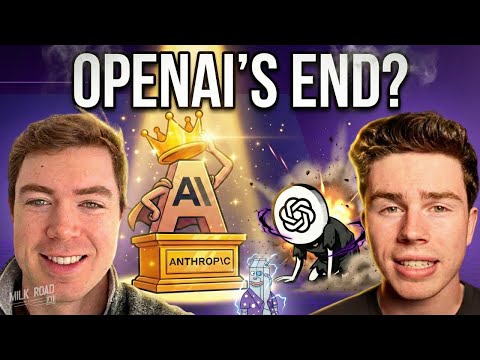
Trillion-dollar AI compute investments create market divergence: immediate monetization (Meta) is rewarded, while slower conversion (Microsoft) faces skepticism, as geopolitical tensions rise over open-source model parity.
Prioritize AI models balancing raw intelligence with superior user experience and collaborative features, as developer loyalty and enterprise adoption increasingly hinge on usability.
The AI landscape is rapidly reordering. Investors and builders must assess monetization pathways, geopolitical implications, and AI's social contract over the next 6-12 months.
The Macro Trend: The transition from opaque scaling to verifiable reasoning.
The Tactical Edge: Audit your models for brittleness by testing them on edge cases that require first principles logic rather than historical data.
The Bottom Line: The next winners in AI will not have the biggest models but the most verifiable ones. If you cannot prove how a model reached a conclusion, you cannot trust it in production.
The transition from more data to better thinking via inference-time compute. Reasoning is becoming a post-training capability rather than a pre-training byproduct.
Use AI for anti-gravity coding to automate bug fixes and data visualization. Treat the model as a passive aura that buffs the productivity of every senior engineer.
AGI will not be a collection of narrow tools but a single model that reasons its way through any domain. The gap between closed labs and open source is widening as these reasoning tricks compound.
The transition from static LLMs to interactive world models marks the move from AI as a tool to AI as a persistent environment.
Monitor the Hugging Face release of the 2B model to build custom image-to-experience wrappers for niche training or spatial entertainment.
Local world models will become the primary interface for spatial computing within the next year, making high-end local compute more valuable than cloud-based streaming.
The Strategic Pivot: The transition from "Understanding-First" science to "Prediction-First" engineering. We are building artifacts that work perfectly but remain theoretically opaque.
The Tactical Edge: Audit your AI stack for "Leaky Abstractions." Don't assume a model's reasoning capabilities in one domain will hold when the underlying causal structure changes.
AGI isn't just an engineering milestone; it's a philosophical wager. If the brain isn't a computer, we are building a very powerful helicopter, not a synthetic human.
The pivot from "Understanding-First" science to "Prediction-First" engineering creates massive technical liability in our models.
Audit your AI implementations for "Leaky Abstractions" where the model fails to account for physical edge cases.
High-performance automation is not the same as sentient reasoning. Builders who recognize this distinction will avoid the cultural illusion of inevitable AGI.
The transition from deterministic software to agentic networks. Companies are moving from rigid workflows to fluid systems that plan and execute autonomously.
Build an internal LLM gateway early. Centralizing model routing and cost monitoring allows you to swap providers as the model horse race changes without refactoring your product.
AI is not just a feature but a fundamental restructuring of the corporate cost center. Efficiency gains allow a static headcount of 300 engineers to support a business growing 5x.
1. Focus on Financial Utility: Crypto's strongest and most sustainable applications remain within the financial sector, emphasizing the need for robust, revenue-generating projects over speculative tokens.
2. Leverage AI for Innovation: Startups that effectively integrate AI to solve real-world problems, particularly in personalized applications, are poised for significant growth and competitive advantage.
3. Embrace Tokenization: The future of equity and capital formation lies in tokenizing shares and streamlining IPO processes on-chain, presenting a transformative opportunity for startups and investors alike.
1. Solana’s Dependence on Meme Coins: While meme coins drive substantial revenue for Solana, they also introduce significant vulnerabilities amid changing market sentiments and regulatory pressures.
2. Staking Yield Dynamics: Proposed reductions in staking yields are unlikely to trigger mass unstaking but will push the ecosystem towards more liquid and innovative staking solutions.
3. Kaido’s Tokenomics Potential: Emerging platforms like Kaido offer novel tokenomics and AI integration, presenting new opportunities and challenges in monetizing user engagement and attention.
1. Major Hacks Undermine Trust: The Bybit hack exemplifies the vulnerabilities in crypto security and the sophisticated methods of state-affiliated hackers.
2. Insider Scandals Expose Systemic Flaws: The Libra scandal reveals deep-seated issues in meme coin launches, highlighting the need for greater transparency and regulation.
3. Regulatory Shifts Offer Hope: Positive moves by the SEC and the CFTC signal a more supportive regulatory landscape, encouraging legitimate crypto innovation.
1. ZK Technology is Transformative: Zero-Knowledge proofs are not only scalable and secure but are also finding essential applications in decentralized finance, particularly in proving exchange solvency without sacrificing performance.
2. Hashflow Leads with Innovation: By leveraging ZK, Hashflow is positioned as a frontrunner in creating high-performance, secure exchanges that offer a user-friendly experience, potentially setting a new standard for the industry.
3. Real-Time Proving is the Future: The advancement towards real-time proving will revolutionize cross-chain interactions and user experiences, making decentralized exchanges as fast and reliable as their centralized counterparts.