The Macro Shift: Celebrity capital is moving from transactional endorsements to strategic equity investments, driven by a desire for long-term wealth creation and the recognition that personal brand power can significantly accelerate startup growth.
The Tactical Edge: Cultivate a diverse network of mentors and partners, prioritizing those who bring complementary expertise and can challenge your assumptions.
The Bottom Line: The future of wealth creation for high-profile individuals and savvy investors lies in strategic, long-term equity plays, supported by strong teams and a willingness to partner.
AI agents with system-level access are shifting the core value proposition of software from discrete applications to fluid, context-aware personal assistants.
Cultivate "agent empathy" by learning to guide AI models effectively, understanding their limitations, and designing projects for agent-first navigation.
The rise of autonomous agents will redefine software's purpose and value.
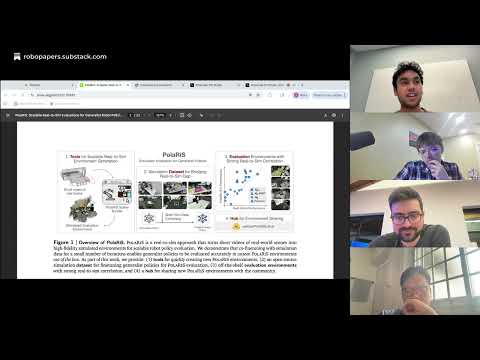
Adopt PolaRiS for rapid policy iteration. Leverage its real-to-sim environment generation and minimal sim data co-training to quickly validate robot policies in diverse, unseen environments before committing to expensive real-world deployments.
The era of generalist robot policies demands a new paradigm for evaluation. The shift is from bespoke, real-world testing to scalable, high-fidelity sim-to-real correlation, enabling faster iteration and broader generalization testing.
Reliable sim-to-real evaluation is the missing link for accelerating robot AI. PolaRiS offers a pragmatic, community-driven path to unlock faster development cycles and more robust generalist robot policies over the next 6-12 months.
Generalist robot policies demand evaluation that tests true generalization across diverse, unseen environments. The shift is from hand-tuned, task-specific benchmarks to scalable, community-driven evaluation suites that can keep pace with rapidly improving model capabilities. This requires tools that make environment creation cheap and ensure real-world predictive power.
Adopt PolaRiS for rapid, correlated policy iteration. Builders should leverage its real-to-sim environment generation (Gaussian splatting for scenes, generative models for objects) and the "sim co-training" trick to quickly validate policy improvements against real-world performance, especially for pick-and-place tasks. Contribute new environments to the Polaris Hub to expand the collective benchmark.
The future of robotics hinges on fast, reliable evaluation. PolaRiS offers a pragmatic, immediate solution to accelerate policy development by providing high-fidelity, correlated sim environments. Over the next 6-12 months, expect this hybrid approach to become a standard for iterating on generalist robot policies, while fully learned world models continue to improve for more complex, deformable tasks.
The push for generalist robot policies demands scalable, trustworthy evaluation. PolaRiS democratizes high-fidelity sim evaluation, moving robotics closer to rapid iteration cycles seen in other AI fields.
Builders should explore PolaRiS's open-source tools and pre-trained checkpoints to quickly test policies in diverse, real-world-correlated environments. Prioritize visual fidelity and use small, unrelated sim data for alignment.
Rapid, reliable sim evaluation with strong real-world correlation is a significant advancement. This tool enables faster policy iteration, broader generalization, and community-driven benchmarking, setting the stage for the next generation of robot capabilities.
Generalist robot policies demand community-driven, scalable evaluation, mirroring LLM benchmarking. PolaRiS provides the technical foundation by making high-fidelity, correlated sim environments accessible.
Adopt PolaRiS for rapid policy iteration. Use its browser-based scene builder and Gaussian splatting for quick environment creation, incorporating minimal, unrelated sim co-training data for strong real-world correlation.
PolaRiS accelerates robot development with a reliable, scalable simulation tool. This means faster iteration, more robust policies, and a clearer path to real-world deployment for your robot applications over the next 6-12 months.
The era of generalist robot policies demands evaluation tools that can keep pace with rapid development and broad generalization. PolaRiS pushes robotics toward the LLM benchmark paradigm, where models are tested on unseen environments and tasks, rather than being trained on specific benchmarks.
For builders, leverage PolaRiS's browser-based scene builder and Gaussian splatting pipeline to quickly create diverse, high-fidelity evaluation environments from real-world scans. This enables faster policy iteration and more reliable real-world deployment.
PolaRiS offers a pragmatic, scalable path to more effective robot policy development. By providing a tool that makes sim performance a reliable predictor of real-world success, it accelerates the journey from lab to real-world application, especially for pick-and-place tasks, and sets the stage for community-driven benchmarking.
Celebrity capital is evolving from passive endorsements to active, strategic equity investment, transforming athletes and entertainers into powerful venture partners who bring more than just money to the table.
Prioritize building a diverse, expert team that can challenge your assumptions and vet opportunities, especially when entering new sectors like AI or overlooked geographic markets.
Long-term thinking, a willingness to invest in growth, and a focus on strategic partnerships are non-negotiable for building lasting wealth and influence in both traditional and emerging industries over the next 6-12 months.
1. Blackbird is pioneering a blockchain-based loyalty and payment system that could redefine restaurant economics by eliminating costly intermediaries.
2. The dual-token system of Fly and F2 ensures both consumer engagement and network governance, offering a unique value proposition.
3. For developers and investors, Blackbird exemplifies how blockchain can be leveraged to create real-world value and user ownership, setting a precedent for future applications.
1. Understanding the cyclical nature of crypto markets is essential for strategic investment. Deploying capital during downturns can lead to significant gains.
2. Integrity, humility, and adaptability are critical traits for founders seeking long-term success in the crypto space.
3. Investors should focus on deep research to identify undervalued opportunities, particularly in DeFi and real-world assets.
1. Bybit’s Large-Scale Hack Highlights the Need for Robust Security: The $1.4 billion ETH breach underscores the importance of advanced security measures and resilient infrastructure in preventing and mitigating massive crypto exploits.
2. Sustainable Airdrop Models are Crucial for Long-Term Success: Kaido’s extensive airdrop strategy reveals the tension between immediate community engagement and the necessity for sustainable token distribution practices to ensure lasting protocol viability.
3. Regulatory Clarity Will Shape the Future of Token Launches: As regulatory bodies like the SEC begin to provide clearer guidelines, the crypto industry must adapt to new rules that can legitimize token offerings and foster a more stable market environment.
1. Enhanced Security through Ethereum: By outsourcing consensus to Ethereum, MegaETH leverages a highly secure and decentralized network, minimizing vulnerabilities associated with centralized consensus mechanisms.
2. Performance Optimization: Avoiding its own consensus process allows MegaETH to reduce latency and boost transaction speeds, making it a high-performance blockchain solution.
3. Strategic Leveraging of Established Protocols: Developers and investors should consider the benefits of utilizing established consensus protocols like Ethereum’s to ensure robust security while focusing on other aspects of blockchain performance.
1. NEAR is pioneering a unified blockchain infrastructure integrating AI, eliminating the need for multiple chains and enhancing user experience.
2. The launch of NEAR 2.0 with fully sharded architecture and reduced block times positions NEAR as a scalable and high-performance blockchain platform.
3. NEAR’s focus on chain abstraction and Trusted Execution Environments sets it apart from other blockchain and Layer 2 solutions, offering a more seamless and secure user experience.