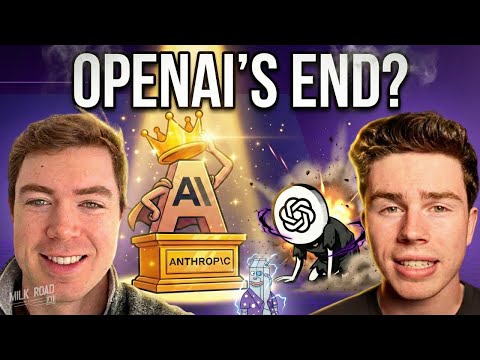
Trillion-dollar AI compute investments create market divergence: immediate monetization (Meta) is rewarded, while slower conversion (Microsoft) faces skepticism, as geopolitical tensions rise over open-source model parity.
Prioritize AI models balancing raw intelligence with superior user experience and collaborative features, as developer loyalty and enterprise adoption increasingly hinge on usability.
The AI landscape is rapidly reordering. Investors and builders must assess monetization pathways, geopolitical implications, and AI's social contract over the next 6-12 months.
The Macro Trend: The transition from opaque scaling to verifiable reasoning.
The Tactical Edge: Audit your models for brittleness by testing them on edge cases that require first principles logic rather than historical data.
The Bottom Line: The next winners in AI will not have the biggest models but the most verifiable ones. If you cannot prove how a model reached a conclusion, you cannot trust it in production.
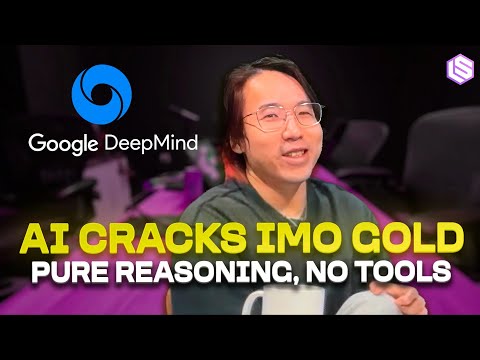
The transition from more data to better thinking via inference-time compute. Reasoning is becoming a post-training capability rather than a pre-training byproduct.
Use AI for anti-gravity coding to automate bug fixes and data visualization. Treat the model as a passive aura that buffs the productivity of every senior engineer.
AGI will not be a collection of narrow tools but a single model that reasons its way through any domain. The gap between closed labs and open source is widening as these reasoning tricks compound.
The transition from static LLMs to interactive world models marks the move from AI as a tool to AI as a persistent environment.
Monitor the Hugging Face release of the 2B model to build custom image-to-experience wrappers for niche training or spatial entertainment.
Local world models will become the primary interface for spatial computing within the next year, making high-end local compute more valuable than cloud-based streaming.
The Strategic Pivot: The transition from "Understanding-First" science to "Prediction-First" engineering. We are building artifacts that work perfectly but remain theoretically opaque.
The Tactical Edge: Audit your AI stack for "Leaky Abstractions." Don't assume a model's reasoning capabilities in one domain will hold when the underlying causal structure changes.
AGI isn't just an engineering milestone; it's a philosophical wager. If the brain isn't a computer, we are building a very powerful helicopter, not a synthetic human.
The pivot from "Understanding-First" science to "Prediction-First" engineering creates massive technical liability in our models.
Audit your AI implementations for "Leaky Abstractions" where the model fails to account for physical edge cases.
High-performance automation is not the same as sentient reasoning. Builders who recognize this distinction will avoid the cultural illusion of inevitable AGI.
The transition from deterministic software to agentic networks. Companies are moving from rigid workflows to fluid systems that plan and execute autonomously.
Build an internal LLM gateway early. Centralizing model routing and cost monitoring allows you to swap providers as the model horse race changes without refactoring your product.
AI is not just a feature but a fundamental restructuring of the corporate cost center. Efficiency gains allow a static headcount of 300 engineers to support a business growing 5x.
1. Blackbird is pioneering a blockchain-based loyalty and payment system that could redefine restaurant economics by eliminating costly intermediaries.
2. The dual-token system of Fly and F2 ensures both consumer engagement and network governance, offering a unique value proposition.
3. For developers and investors, Blackbird exemplifies how blockchain can be leveraged to create real-world value and user ownership, setting a precedent for future applications.
1. Understanding the cyclical nature of crypto markets is essential for strategic investment. Deploying capital during downturns can lead to significant gains.
2. Integrity, humility, and adaptability are critical traits for founders seeking long-term success in the crypto space.
3. Investors should focus on deep research to identify undervalued opportunities, particularly in DeFi and real-world assets.
1. Bybit’s Large-Scale Hack Highlights the Need for Robust Security: The $1.4 billion ETH breach underscores the importance of advanced security measures and resilient infrastructure in preventing and mitigating massive crypto exploits.
2. Sustainable Airdrop Models are Crucial for Long-Term Success: Kaido’s extensive airdrop strategy reveals the tension between immediate community engagement and the necessity for sustainable token distribution practices to ensure lasting protocol viability.
3. Regulatory Clarity Will Shape the Future of Token Launches: As regulatory bodies like the SEC begin to provide clearer guidelines, the crypto industry must adapt to new rules that can legitimize token offerings and foster a more stable market environment.
1. Enhanced Security through Ethereum: By outsourcing consensus to Ethereum, MegaETH leverages a highly secure and decentralized network, minimizing vulnerabilities associated with centralized consensus mechanisms.
2. Performance Optimization: Avoiding its own consensus process allows MegaETH to reduce latency and boost transaction speeds, making it a high-performance blockchain solution.
3. Strategic Leveraging of Established Protocols: Developers and investors should consider the benefits of utilizing established consensus protocols like Ethereum’s to ensure robust security while focusing on other aspects of blockchain performance.
1. NEAR is pioneering a unified blockchain infrastructure integrating AI, eliminating the need for multiple chains and enhancing user experience.
2. The launch of NEAR 2.0 with fully sharded architecture and reduced block times positions NEAR as a scalable and high-performance blockchain platform.
3. NEAR’s focus on chain abstraction and Trusted Execution Environments sets it apart from other blockchain and Layer 2 solutions, offering a more seamless and secure user experience.