The AI revolution in biology is moving from prediction to generation, enabling the de novo design of molecules with specific functions. This shift, driven by specialized architectures and open-source efforts, is fundamentally changing how new drugs and biological tools are discovered.
Invest in platforms that productize complex AI models with robust, real-world validation. For builders, focus on user experience and infrastructure that abstracts away computational complexity, making advanced tools accessible to domain experts.
The ability to reliably design novel proteins and small molecules will unlock unprecedented speed and efficiency in drug discovery over the next 6-12 months. Companies that can bridge the gap between cutting-edge AI models and practical, validated lab results will capture significant value.
AI in biology is rapidly transitioning from predictive analytics to generative design, demanding specialized models that integrate complex biophysical priors and robust, real-world experimental validation to move from theoretical predictions to tangible, novel molecules.
Builders and investors should prioritize platforms that not only offer state-of-the-art generative models but also provide scalable infrastructure, intuitive interfaces, and a commitment to open-source development and rigorous experimental validation, lowering the barrier for scientific innovation.
The ability to design new proteins and small molecules with AI is no longer science fiction; it's a rapidly maturing field. Companies that can effectively bridge the gap between cutting-edge AI research and practical, validated tools will capture significant value in the accelerating race for new therapeutics and biotechnologies.
The AI industry is moving from a focus on raw model size to a sophisticated interplay of frontier research, efficient distillation, and specialized hardware. This means the "best" model isn't just the biggest, but the one optimized for its specific deployment context, driven by energy efficiency and latency.
Prioritize investments in hardware and software architectures that enable extreme low-latency inference and multimodal processing. For builders, this means designing systems that can leverage both powerful frontier models for complex tasks and highly optimized "flash" models for ubiquitous, real-time applications.
The next 6-12 months will see a continued acceleration in AI capabilities, driven by a relentless focus on making models faster, cheaper, and more context-aware. Companies that excel at distilling cutting-edge AI into deployable, low-latency solutions will capture significant market share and redefine user expectations.
The AI industry is consolidating around unified, multimodal general models, moving past the era of highly specialized, single-task AI. This means foundational models will increasingly serve as the base for all applications, with specialized knowledge integrated via retrieval or modular training.
Invest in low-latency AI infrastructure and model architectures. The future of AI interaction hinges on near-instantaneous responses, enabling complex, multi-turn reasoning and agentic workflows that are currently bottlenecked by speed and cost.
The race for AI dominance is a full-stack game: superior hardware, efficient model architectures, and smart deployment strategies are inseparable. Companies that master this co-evolution will capture the next wave of AI-driven productivity and user experience.
The open-source AI movement is democratizing advanced scientific tools, particularly in generative biology, forcing a re-evaluation of proprietary models' long-term impact on innovation.
Builders and investors should prioritize platforms that combine cutting-edge open-source models with robust, scalable infrastructure and extensive experimental validation.
The future of drug discovery will be driven by accessible, validated generative AI platforms that empower a broad scientific community, rather than relying on a few closed, black-box solutions. This means faster iteration, lower costs, and a higher probability of discovering novel therapeutics in the next 6-12 months.
Prioritize low-latency AI interactions and invest in tools that enable precise, multimodal prompting.
The relentless pursuit of AI capability is increasingly tied to the energy efficiency of data movement, driving a co-evolution of model architectures and specialized hardware.
The next 6-12 months will see a significant acceleration in personalized AI experiences and a continued push for ultra-low latency models, making crisp communication with AI a competitive advantage.
The rise of autonomous AI agents is fundamentally reconfiguring the digital economy, transforming traditional software applications into agent-addressable services and democratizing building by lowering the technical bar for creation.
Invest in platforms and tools that prioritize agent-friendly APIs and open-source collaboration, as these will capture the next wave of digital value creation.
Personal AI agents are not just tools; they are a new operating system layer that will redefine how we interact with technology and each other. Understanding this shift is critical for navigating the next 6-12 months of rapid innovation and market disruption.
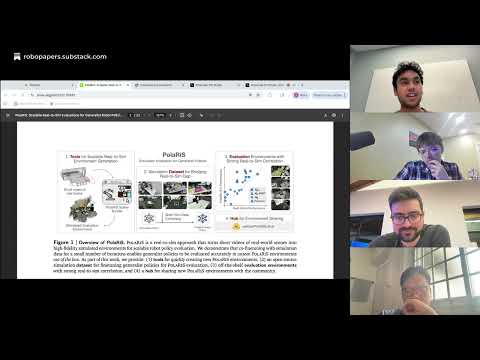
Adopt PolaRiS for policy iteration. Builders should use its browser-based scene builder and Gaussian splatting pipeline to quickly create new, diverse evaluation environments from real-world scans.
Integrate minimal, unrelated sim data into policy training to dramatically boost real-to-sim correlation, allowing for faster, cheaper development cycles before costly real-world deployment.
PolaRiS shifts the focus from hand-crafted, task-specific simulations to scalable, real-world-correlated benchmarks, enabling rapid iteration and generalization testing previously impossible in robotics.
Agentic AI is changing software from discrete applications to an integrated, conversational operating layer, making human intent the primary interface for complex tasks.
Invest in or build platforms that prioritize agent-friendly APIs and open-source collaboration, as these will capture the next wave of user interaction and value generation.
The future of computing is agent-centric; understanding and adapting to this paradigm change is crucial for staying relevant in the quickly evolving tech landscape over the next 6-12 months.
Buy the Fear (Selectively): Target Bitcoin dips aggressively in the $73k-$78k zone for mid-term holds, anticipating a potential reversal once tariff fears subside.
Short the Weakness: Ethereum presents a compelling short opportunity targeting $1500 or lower; most altcoins remain vulnerable until market sentiment improves.
Trade Nimbly, Hedge Wisely: This market rewards quick profit-taking on bounces and punishing overstayed welcomes. Use put options to hedge against unpredictable downside moves in this "once-in-80-year" tariff scenario.
Brace for Impact, Watch for Stimulus: Tariffs likely guarantee short-term economic pain and recession risk, but expect swift policy responses (tax cuts) if things get too dire.
Bitcoin > Alts (Mostly): Prioritize Bitcoin exposure due to relative strength. Altcoins (especially ETH) face severe headwinds; shorting weak names is viable. Keep an eye on the RWA narrative.
Trade the Extremes: Volatility is the game. Buy deep fear ($73-78k BTC zone), sell rips quickly, stay nimble, and don't overexpose yourself without hedges.
Finance is Moving On-Chain: The future isn't siloed databases using the internet for messaging; it's financial ledgers living on unified, open-access blockchains – the true Internet Financial System.
Strong Property Rights, Stronger Economies: Blockchains provide globally accessible, technologically enforced property rights, bypassing weak local legal systems and unlocking trillions in capital – a massive driver for global development.
Crypto Grows Up: The era of pure speculation and inert protocols is fading; sustainable businesses, real cash flows, and robust token holder rights are the new requirements for success and investment.
Timelines are Fluid Until Scheduled: Don't treat estimated Ethereum upgrade windows discussed early in development as hard deadlines; "delays" only truly occur after a specific date is set and missed.
Communication is Hard: Core developers wrestle with how much certainty to project about timelines, balancing the need for transparency against the risks of premature commitment or unhelpful vagueness.
Manage Expectations: Observers and investors should factor the inherent uncertainty of deep R&D into their expectations regarding Ethereum upgrade timelines.
**Meme Coins Persist:** Pump.fun's combined volume nears ATHs post-Pump Swap launch; the game evolves, integrating social features (Zora) and platform revenue sharing, rather than disappearing.
**Fees Aren't Everything:** Tron's high network fees mask an application-light ecosystem heavily reliant on CEX USDT flows, unlike Solana's more balanced app/chain fee structure.
**Stablecoin Yield Ban Reshapes Market:** No native yield benefits incumbent issuers (Circle/Tether) and potentially DeFi, pushing yield generation to adjacent protocols and complicating the 'stablecoins fund US debt' narrative.
Zora is pioneering a shift from illiquid NFTs to fungible content coins, creating liquid markets around individual pieces of online media. This model aims to empower the long tail of creators and build a more open, composable, and value-aligned internet economy beyond ads and subscriptions.
**Content is Fungible:** The market realized many NFTs were traded fungibly; coins offer a more efficient market structure for most online content.
**Attention Markets Emerge:** Crypto enables open markets to price the attention and cultural relevance of content, moving beyond ad exchanges.
**Simplified Creator Monetization:** Zora provides tools for creators to easily tokenize content and earn directly via integrated market mechanisms (LP fees), often surpassing earnings on traditional platforms.