The rise of autonomous AI agents will fundamentally reshape the app economy, rendering many single-purpose applications obsolete as agents integrate and automate tasks across systems. This forces companies to either become agent-facing APIs or risk irrelevance.
Cultivate "agent empathy" by understanding how models perceive codebases and problems. This skill, combined with a willingness to experiment and "play," is crucial for effectively guiding agents to build and refactor software.
The agentic AI era demands a shift from traditional programming to a builder mindset, where human creativity and strategic guidance become paramount. Investors should seek platforms enabling this shift, and builders must adapt to a world where natural language is the new code.
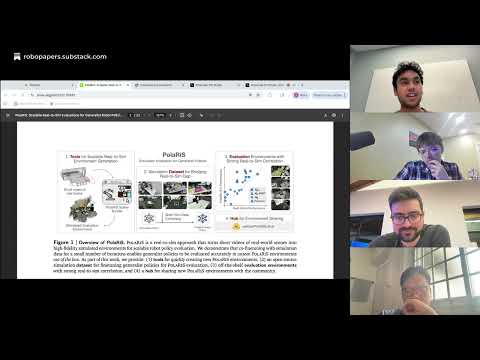
Robotics is moving towards generalist policies, demanding scalable, high-fidelity evaluation tools that mirror the real world, away from task-specific benchmarks.
Adopt PolaRiS for rapid policy iteration and generalization testing, especially for pick-and-place tasks, leveraging easy environment creation and proven real-to-sim correlation.
PolaRiS provides critical infrastructure for accelerating robot learning, enabling builders to quickly validate policies against real-world performance without prohibitive cost.
AI agents are transforming software development from a manual coding craft into an "agentic engineering" discipline, where human builders orchestrate and guide autonomous AI systems. This shift means the value moves from writing boilerplate code to designing agent-friendly architectures and providing high-level strategic direction.
Embrace agentic engineering by learning to "empathize" with AI models, understanding their context limitations, and guiding them with concise, clear prompts. Experiment with open-source agents like OpenClaw to build new tools or automate existing workflows, focusing on the what and why rather than the how.
Personal AI agents will commoditize many existing apps and services, forcing companies to either become agent-facing APIs or risk obsolescence. Investors should identify platforms and infrastructure that enable agent interoperability, while builders should focus on creating agent-native experiences and tools that augment human creativity, rather than replicating existing app functionality.
Robotics is moving beyond isolated tasks to generalist policies, demanding scalable, correlated evaluation methods. This mirrors the LLM world's need for diverse, generalization-focused benchmarks.
Utilize PolaRiS's open-source tools and Hugging Face hub to quickly create and share new evaluation environments. This crowdsourcing approach accelerates community-wide progress in robot policy development.
Investing in tools like PolaRiS that bridge the real-sim gap with high-fidelity visuals and minimal sim co-training is crucial. This enables faster policy iteration and more reliable real-world deployment for the next generation of generalist robots.
The macro shift: Generalist robot policies need generalist evaluation. The shift is from hand-crafted, task-specific sim environments to easily generated, real-world-correlated simulations that test zero-shot generalization, mirroring the rapid benchmark development in LLMs. This allows for a holistic understanding of policy capabilities across diverse, unseen scenarios.
The tactical edge: Adopt PolaRiS for rapid policy iteration. Builders should use its browser-based scene builder and Gaussian Splatting to quickly create new, diverse evaluation environments from real-world scans, then fine-tune policies with small, unrelated sim data to achieve high real-to-sim correlation. This accelerates development cycles and reduces costly real-world testing.
The future of robotics hinges on scalable, trustworthy evaluation. PolaRiS provides a critical tool today to bridge the sim-to-real gap, enabling faster, more reliable development of generalist robot policies. Expect a community-driven explosion of benchmarks, pushing robot capabilities faster than ever over the next 6-12 months.
The robotics community needs to move beyond task-specific benchmarks with provided training data towards a diverse suite of generalization-focused evaluations, mirroring the LLM ecosystem. PolaRiS provides the tools to crowdsource and rapidly deploy these new benchmarks, fostering a more holistic understanding of robot policy capabilities.
For robot policy developers, prioritize tools like PolaRiS that offer high real-to-sim correlation with minimal setup. Leverage its browser-based scene builder and the "visual vaccination" co-training method to quickly iterate on policies for pick-and-place and articulated object tasks, then validate on real hardware.
Scalable, correlated simulation is the missing piece for accelerating generalist robot AI. Over the next 6-12 months, the adoption of tools like PolaRiS will enable faster policy iteration, more robust benchmarking, and ultimately, a quicker path to deploying capable robots in diverse, unstructured environments.
The robotics community is moving from hand-crafted, task-specific simulations to generalist policies that demand scalable, real-world correlated evaluation. PolaRiS enables this by making it cheap and easy to create diverse, high-fidelity sim environments from real scans, allowing for generalization testing akin to LLM benchmarks.
Implement PolaRiS for rapid policy iteration. Use its real-to-sim environment generation and minimal, unrelated sim data co-training to quickly validate robot policies against real-world performance, reducing costly physical robot time.
PolaRiS offers a critical infrastructure upgrade for robot AI development. By providing a fast, reproducible, and highly correlated simulation environment, it allows builders to iterate on generalist robot policies at software speed, significantly de-risking and accelerating the path to real-world deployment and broader robot capabilities over the next 6-12 months.
The drive for generalist robot policies demands scalable, reliable evaluation. PolaRiS pushes robotics toward the community-driven, diverse benchmarking common in LLMs, accelerating the path to truly capable robots.
Adopt PolaRiS for rapid policy iteration and generalization testing. Leverage its easy environment creation and proven real-to-sim correlation to quickly validate new robot behaviors before costly real-world deployment.
PolaRiS is a critical tool for any team building robot policies. It cuts evaluation costs, speeds up development, and provides a trustworthy signal for real-world performance, making it a must-have for your robotics roadmap over the next 6-12 months.
Builders should prioritize hybrid real-to-sim evaluation tools like PolaRiS for rapid policy iteration.
Use minimal, out-of-domain sim data to align policies to the simulation environment, ensuring your sim results accurately predict real-world performance.
Investing in tools that democratize benchmark creation and ensure strong real-to-sim correlation will accelerate robot policy development.
Specialization Wins: General-purpose blockchains struggle to optimally serve the massive, specific needs of stablecoin transfers; dedicated infrastructure like Plasma is required to unlock the next phase of growth.
USDT is the Global Standard: Tether's dominance, especially outside the US, mirrors the Eurodollar system. It's the Schelling point for international digital dollars, unlikely to be displaced by domestic-focused or bank-issued alternatives.
Focus on Fundamentals: Plasma bets on core utility (cheap/free, fast, secure transfers) and deep integrations over complex tokenomics, aiming to capture trillions in real-world commerce settlement.
Valuations & Policy Collide: Overly optimistic markets hit a wall of peak valuations, expiring liquidity, and initially growth-negative policies.
Bitcoin vs. The World: Bitcoin's near-term strength is tied to potential forced central bank liquidity, while major upside requires a breakdown in traditional fiscal/monetary stability. Prioritize BTC over most alts.
Cash & Caution: Elevated volatility persists. Holding cash and focusing on resilient sectors (e.g., critical resources, energy) is prudent while navigating potential deleveraging events and geopolitical risks.
Adversarial Advantage: Bittensor's miners are exceptionally efficient at finding flaws in AI models, turning a potential vulnerability into a powerful, real-time stress-testing mechanism crucial for robust drug discovery AI.
Incentivizing Innovation: Token emissions provide funding and incentives for tackling high-risk, high-reward drug discovery challenges that traditional models struggle to support, fostering novelty over incrementalism.
Digital-to-Physical Bridge: Nova plans to translate computational discoveries into real-world value through synthesis, lab validation, and strategic partnerships, aiming to become a pioneering crypto-native biotech entity.
Dollar Under Pressure: Aggressive US trade policies risk eroding the dollar's reserve status, making diversification into assets like gold and Bitcoin increasingly rational.
Bitcoin's Moment: Bitcoin showed relative strength during market panic, bolstering its narrative as a non-sovereign hedge against policy error; it could be the "fastest horse" in a dollar diversification race.
Navigating Volatility: For traders, volatility is opportunity (buy dips, anticipate intervention); for investors, it requires a long-term view, potentially adjusting allocations (e.g., less equities/bonds, more gold/BTC) and using dips strategically.
Solana's Tech Momentum is Real: 2025's roadmap (Firedancer, consensus changes, block space) represents a major technical leap, potentially solidifying its performance edge and driving the next narrative cycle.
Narrative & TradFi Wrappers: Solana needs to refine its mainstream story. While corporate treasury plays offer indirect exposure, their long-term impact and differentiation remain uncertain without strong figureheads or unique value propositions beyond mimicking MicroStrategy.
Stablecoin Wars Heat Up: The dominance of USDC on Solana highlights underlying strategic tensions. Expect ecosystems and apps to increasingly incentivize stablecoin usage that aligns directly with their own growth, potentially shifting away from implicitly subsidizing competitors like Base via USDC fees.
Subnets Shine Independently: Subnet token prices are detaching from TAO/macro trends, signaling market recognition of their intrinsic value and utility.
Utility & Tooling Drive Growth: Making it easier for miners/devs to participate (e.g., Ready AI's toolkit) and showcasing real-world applications (e.g., AI agents) are key strategies for subnet traction.
Marketing Requires Substance & Transparency: In the dTAO world, public roadmaps, clear communication, and demonstrating tangible progress are crucial for attracting attention and investment.