The Macro Shift: The Great Re-Shoring. National security now depends on domestic production of critical minerals and semiconductors.
The Tactical Edge: Build for Scale. Prioritize manufacturing competence over pure software features to win government contracts.
The Bottom Line: The defense industrial base is being rebuilt from the ground up. The next decade belongs to the builders who can merge Silicon Valley speed with the Pentagon's scale.
The Macro Trend: Biological Sovereignty. As global systems destabilize, the Amazon remains the most critical piece of biological infrastructure on the planet.
The Tactical Edge: Support Jungle Keepers. Direct capital to organizations that convert loggers into rangers to secure land concessions.
The Amazon is a finite asset under active siege. Protecting it requires a blend of primitive survival skills and high-tech surveillance over the next 18 months.
The Macro Pivot: As generative AI masters simulation, the physical world becomes a high-fidelity playground for software.
The Tactical Edge: Invest in the "brain" layer rather than the "limb" layer. Software that can generalize across different hardware forms will capture the most value.
The next decade belongs to embodied AI that reasons in real time. If you are waiting for the hardware to look perfect before paying attention, you will miss the moment the software takes over the physical world.
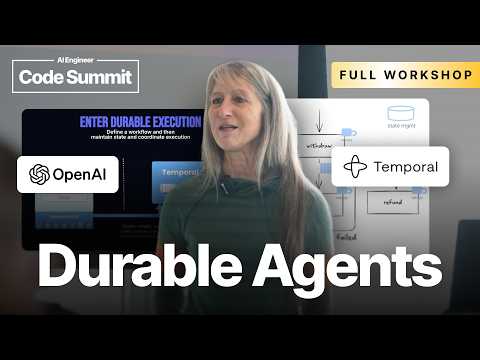
The industry is moving from "Agent as a Script" to "Agent as a Durable Service" where state management is handled by the infrastructure.
Wrap your existing API tools in the `activity_as_tool` function to gain automatic retries and execution history.
Reliability is the only moat in the agentic economy. If your agent cannot survive a server restart during a three-day task, it is not ready for the enterprise.
The Macro Trend: The move from fragmented content libraries to integrated health systems where AI synthesizes biomarkers and movement.
The Tactical Edge: Construct internal LLM tools to categorize qualitative feedback. This turns thousands of raw reviews into a precise roadmap.
The Bottom Line: Building a $100M ARR consumer app requires mastery of both growth loops and product retention. Solve for the daily habit to win the long game.
The transition from general-purpose AI to specialized application layers. As foundation models commoditize, value migrates to the "fat tail" of human-centric complexity.
Prioritize building or investing in "DNA of the future" companies that incumbents must eventually acquire to survive. Focus on winning the "point of attack" by staying deep in the technical details.
We are in a unique market where demand growth justifies high valuations. Success over the next year depends on identifying founders who are the absolute best in the world at one specific thing.
The Macro Shift: Institutional players are not just buying crypto; they are actively building and acquiring talent to integrate blockchain rails into existing financial infrastructure. This means the battle for crypto's future will increasingly be fought on the grounds of productization and distribution, not just raw technical innovation.
The Tactical Edge: Investigate projects that are actively bridging the gap between open-source crypto and traditional finance, but with clear, transparent tokenomics and governance structures. Prioritize teams willing to disclose financials, as this signals long-term viability and investor alignment in a market often opaque.
The Bottom Line: The next cycle will see a fierce competition between truly decentralized protocols and corporate-backed, crypto-native products. Understanding who owns the rails and how value accrues will be paramount for investors and builders seeking to capitalize on this evolving landscape.
The global financial system is undergoing a fundamental shift towards tokenized money, driven by efficiency gains and demand for dollar access in emerging markets. This transition will upgrade core payment rails, not just add layers.
Builders should focus on infrastructure that collapses existing financial stacks, leveraging stablecoins for global reach and capital efficiency. Investors should seek companies enabling this "under the surface" upgrade, particularly those with direct network memberships.
The future of finance is programmable and global. Companies like Rain, by building core stablecoin infrastructure and securing direct network access, are positioned to capture immense value as more of the world's money moves onchain over the next 6-12 months.
The crypto industry is experiencing a gravitational pull towards institutionalization, where traditional finance and tech giants are increasingly building on or acquiring web3 infrastructure and talent.
Monitor projects like MegaETH that are launching with clear, measurable KPIs for their token generation events.
The next 6-12 months will see increased competition from well-capitalized, traditional players building on crypto rails, potentially limiting direct token exposure to fundamental infrastructure plays.
The Ethereum scaling narrative is evolving from L2s as mere L1 extensions to specialized, high-performance execution layers. This creates a barbell structure where Ethereum provides core security, and L2s deliver extreme throughput and novel features.
Builders should explore high-performance L2s like MegaETH for applications requiring ultra-low latency and high transaction volumes, especially in gaming, DeFi, and AI agent interactions, where traditional fee models are prohibitive.
MegaETH's mainnet launch, with its technical innovations and unconventional economic and app strategies, signals a new generation of L2s.
The theoretical certainty of quantum computing, coupled with accelerating engineering breakthroughs, means the digital asset space must proactively build "crypto agility" into its core protocols. This ensures systems can adapt to new cryptographic standards as current ones become obsolete.
Secure your Bitcoin by ensuring it resides in unspent SegWit or P2SH addresses, as these keep your public key hidden until spent. This provides a temporary shield against quantum attacks.
Quantum computing is not a distant threat but a near-term risk with a 20% chance of moving Satoshi's coins by 2030. Ignoring this could lead to a systemic collapse of the "store of value" narrative for Bitcoin and other digital assets, forcing a costly and painful reset.
The crypto industry must shift from viewing quantum as a distant threat to an imminent engineering challenge requiring proactive, coordinated defense.
Ensure any long-term Bitcoin holdings are in SegWit addresses never spent from, as these public keys remain hashed and are currently more resistant to quantum attacks.
A 20% chance of Satoshi's coins moving by 2030, and near certainty by 2035, means delaying upgrades is a multi-billion dollar bet against Bitcoin's core security narrative.