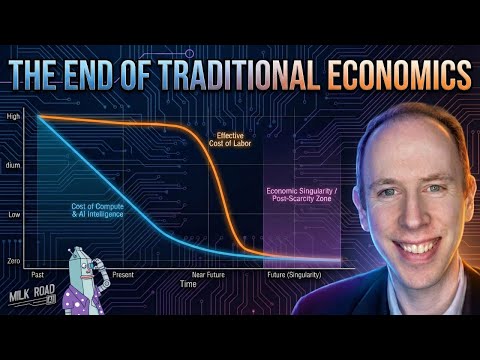
The Macro Shift: AI-driven hyperdeflation is colliding with the technical reality of autonomous AI agents creating their own crypto-backed economies, threatening a decoupling from human fiat systems.
The Tactical Edge: Investigate and build infrastructure that bridges human and AI economies, focusing on fiat-to-crypto rails that can accommodate agent-driven transactions to prevent a complete split.
The Bottom Line: The next 5-10 years will see an unprecedented economic transformation. Understanding AI's deflationary power and the emerging AI agent economy is critical for navigating a world where traditional economic models may no longer apply.
The time of practical AI agents is here, moving compute demand beyond pure GPU inference to a significant reliance on CPUs for coordination, data handling, and security.
Evaluate your agent deployment strategy now, prioritizing sandboxed environments (VPS, dedicated local servers) and exploring cost-optimized model routing to manage API expenses.
Prepare for a future where AI agents become integral to workflows, but recognize the hidden infrastructure costs and security implications, particularly the growing importance of CPU capacity and robust access controls.
The shift from "how" to "why" in AI agent capabilities creates a new, multi-trillion-dollar market for companies that can capture institutional decision logic.
Invest in or build agentic systems that are in the "right path" of business processes, actively capturing decision traces from unstructured data.
Hundreds of context graphs will be in production at scale within a year, defining a new "context graph stack." The winning companies will be those that master this flywheel, extracting value to accelerate automation and build deep, defensible moats.
The shift from linear, bottleneck-driven technological progress to a multi-layered, interconnected advancement model in AI has rendered traditional forecasting obsolete, forcing a re-evaluation of what "singularity" truly represents.
Prioritize adaptability: Invest in modular, composable AI infrastructure and tools that thrive in multi-layered, unpredictable environments, rather than betting on single-bottleneck solutions.
The inability to narrate AI's future means traditional roadmaps are obsolete; success hinges on navigating simultaneous, interconnected advancements and embracing the emergent.
The era of infrastructure-heavy tech deployment is over; AI's internet-native nature means immediate, widespread application. This shifts the competitive advantage from capital-intensive builds to rapid iteration and data leverage.
Invest in companies that are not just using AI, but are fundamentally rethinking their business models around AI's ability to collapse traditional cost structures and accelerate product development.
AI is a force multiplier for both individual opportunity and national power. Understanding its immediate deployability and the new rules of company building is crucial for investors and builders aiming to lead in the next wave of innovation over the next 12-24 months.
Unprecedented fiscal and monetary stimulus, coupled with a deregulatory environment, creates a powerful tailwind for financial assets and tech, driving a capital investment super cycle.
Investors should prioritize companies with proprietary data and GPU access, as these are the new moats in an AI-driven world where traditional software leads are eroding.
The convergence of a stimulative macro environment and AI's disruptive force means capital will flow to those who can scale, innovate, and navigate complex policy landscapes, making strategic positioning now critical for future relevance.
The macro trend of autonomous AI agents is shifting compute demand beyond GPUs, creating an unexpected CPU crunch and forcing a re-evaluation of on-premise inference and cost-optimized model routing for security and efficiency.
Investigate hybrid compute strategies, combining secure local environments (Mac Minis, home servers) with cloud-based LLMs, and explore multi-model API gateways like OpenRouter to optimize agent costs and performance.
AI agents are here, demanding a rethink of your compute stack and security protocols. Prepare for a future where CPU capacity, not just GPU, becomes a critical bottleneck, and strategic cost management for diverse AI models is non-negotiable for competitive advantage.
The move from general-purpose LLMs to specialized AI agents demands a new data architecture that captures the *why* of decisions, not just the *what*. This creates a new, defensible layer of institutional memory, moving value from raw model IP to proprietary decision intelligence.
Invest in or build agentic systems that are in the *orchestration path* of specific business processes. This allows for the organic capture of decision traces, forming a proprietary context graph that incumbents cannot easily replicate.
Over the next 12 months, the ability to build and extract value from context graphs will define the winners in the enterprise AI space, creating a new "context graph stack" that will be 10x more valuable than the modern data stack.
The Macro Shift: Institutional players are not just buying crypto; they are actively building and acquiring talent to integrate blockchain rails into existing financial infrastructure. This means the battle for crypto's future will increasingly be fought on the grounds of productization and distribution, not just raw technical innovation.
The Tactical Edge: Investigate projects that are actively bridging the gap between open-source crypto and traditional finance, but with clear, transparent tokenomics and governance structures. Prioritize teams willing to disclose financials, as this signals long-term viability and investor alignment in a market often opaque.
The Bottom Line: The next cycle will see a fierce competition between truly decentralized protocols and corporate-backed, crypto-native products. Understanding who owns the rails and how value accrues will be paramount for investors and builders seeking to capitalize on this evolving landscape.
The global financial system is undergoing a fundamental shift towards tokenized money, driven by efficiency gains and demand for dollar access in emerging markets. This transition will upgrade core payment rails, not just add layers.
Builders should focus on infrastructure that collapses existing financial stacks, leveraging stablecoins for global reach and capital efficiency. Investors should seek companies enabling this "under the surface" upgrade, particularly those with direct network memberships.
The future of finance is programmable and global. Companies like Rain, by building core stablecoin infrastructure and securing direct network access, are positioned to capture immense value as more of the world's money moves onchain over the next 6-12 months.
The crypto industry is experiencing a gravitational pull towards institutionalization, where traditional finance and tech giants are increasingly building on or acquiring web3 infrastructure and talent.
Monitor projects like MegaETH that are launching with clear, measurable KPIs for their token generation events.
The next 6-12 months will see increased competition from well-capitalized, traditional players building on crypto rails, potentially limiting direct token exposure to fundamental infrastructure plays.
The Ethereum scaling narrative is evolving from L2s as mere L1 extensions to specialized, high-performance execution layers. This creates a barbell structure where Ethereum provides core security, and L2s deliver extreme throughput and novel features.
Builders should explore high-performance L2s like MegaETH for applications requiring ultra-low latency and high transaction volumes, especially in gaming, DeFi, and AI agent interactions, where traditional fee models are prohibitive.
MegaETH's mainnet launch, with its technical innovations and unconventional economic and app strategies, signals a new generation of L2s.
The theoretical certainty of quantum computing, coupled with accelerating engineering breakthroughs, means the digital asset space must proactively build "crypto agility" into its core protocols. This ensures systems can adapt to new cryptographic standards as current ones become obsolete.
Secure your Bitcoin by ensuring it resides in unspent SegWit or P2SH addresses, as these keep your public key hidden until spent. This provides a temporary shield against quantum attacks.
Quantum computing is not a distant threat but a near-term risk with a 20% chance of moving Satoshi's coins by 2030. Ignoring this could lead to a systemic collapse of the "store of value" narrative for Bitcoin and other digital assets, forcing a costly and painful reset.
The crypto industry must shift from viewing quantum as a distant threat to an imminent engineering challenge requiring proactive, coordinated defense.
Ensure any long-term Bitcoin holdings are in SegWit addresses never spent from, as these public keys remain hashed and are currently more resistant to quantum attacks.
A 20% chance of Satoshi's coins moving by 2030, and near certainty by 2035, means delaying upgrades is a multi-billion dollar bet against Bitcoin's core security narrative.