The automotive industry is undergoing a significant architectural change, moving from fragmented, hardware-centric systems to vertically integrated, AI-powered software-defined vehicles. This demands re-platforming, making legacy automakers vulnerable.
Invest in or build companies controlling their full technology stack: custom silicon, sensor arrays, data collection, AI model training. Vertical integration is key to cost efficiency and rapid iteration for mass-market AI autonomy.
The next few years will see dramatic divergence. Companies mastering AI-driven autonomy and software-defined architectures, like Rivian with its R2, will capture significant market share by offering compelling, continuously improving vehicles at scale. Others face obsolescence.
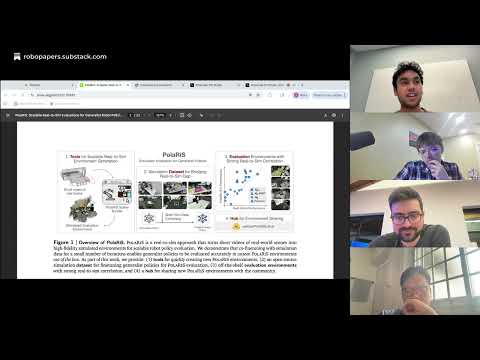
The robotics community is moving beyond task-specific benchmarks towards generalist policy evaluation, mirroring the LLM trend of testing off-the-shelf models on unseen tasks. This demands scalable, high-fidelity simulation tools that can quickly generate diverse test environments.
Builders and researchers should prioritize evaluation tools that offer strong real-to-sim correlation, even if it means a hybrid approach (like PolaRiS) over purely data-driven world models. Utilize real-to-sim environment generation (Gaussian splatting) and strategic sim data co-training to accelerate policy iteration.
PolaRiS offers a path to community-driven, crowdsourced robot benchmarks, making policy development faster and more robust. Expect a future where robot policies are evaluated across a broad suite of easily created, diverse simulated environments, pushing the boundaries of generalization and real-world applicability.
Generalist robot policies need robust, scalable evaluation. The shift is from bespoke, real-world-only testing to a hybrid real-to-sim approach that leverages modern 3D reconstruction and minimal sim data to create highly correlated, reproducible benchmarks.
Builders should adopt PolaRiS's real-to-sim environment generation and "sim co-training" methodology. This allows for rapid, cost-effective iteration on robot policies, ensuring that improvements in simulation translate directly to real-world gains.
Over the next 6-12 months, the ability to quickly and reliably evaluate robot policies in simulation will be a critical differentiator. PolaRiS provides the tools to build diverse, generalization-focused benchmarks, moving robotics closer to the rapid iteration cycles of other AI fields.
Tesla's core identity shifted from EV maker to autonomous AI and robotics. Its cars are devices for deploying its advanced AI brain; competitors miss this.
Tesla's 8 million cars collect real-world driving data. This massive dataset, combined with in-house AI processing, creates an unparalleled moat impossible for competitors to replicate.
This convergence creates an abundance of labor and transportation, driving down costs. Robo-taxis and humanoid robots automate tasks, making goods and services cheaper, even as Tesla's profitability soars.
Robotics is moving towards generalist policies that need broad, diverse evaluation. PolaRiS enables this by making it easy to create and share new, correlated benchmarks, cultivating a community-driven evaluation ecosystem similar to LLMs.
Adopt PolaRiS for rapid policy iteration on pick-and-place and articulated object tasks. Use its browser-based scene builder and existing assets to quickly create new evaluation environments, then fine-tune policies with a small amount of unrelated sim data to boost real-to-sim correlation.
Investing in tools like PolaRiS now means faster development cycles and more reliable policy improvements. This accelerates the path to robust, real-world robot deployment by providing a scalable, trustworthy intermediate testing ground.
PolaRiS enables a shift towards LLM-style generalization benchmarks, where models are tested on unseen environments and tasks, accelerating robot capabilities.
Use its browser-based scene builder and Gaussian splatting to quickly create diverse, real-world correlated evaluation environments, significantly reducing the cost and time of real robot testing.
Cheap, reliable robot policy evaluation in simulation, with strong real-world correlation, means faster development cycles, more robust generalist robots, and a path to crowdsourced, diverse benchmarks that will push the entire field forward.
AI is forcing a fundamental architectural change in automotive, moving from fragmented, rules-based systems to vertically integrated, neural network-powered platforms. This technical reality dictates market survival, favoring companies that control their entire software and hardware stack to build a continuous data flywheel.
Invest in or partner with companies demonstrating deep vertical integration in AI hardware and software for mobility. Prioritize those with a clear path to mass-market data collection and rapid iteration cycles.
Autonomy will be a must-have feature in cars within the next few years. Companies without a software-defined architecture and a vertically integrated AI stack will struggle to compete, creating a market share shift towards those few players who can deliver true self-driving at scale.
The automotive industry is undergoing a fundamental re-architecture, moving from hardware-centric, rules-based systems to software-defined, AI-powered platforms. This shift favors companies with deep vertical integration and proprietary data flywheels.
Invest in companies demonstrating full-stack control over their vehicle's software, hardware, and AI training data. This verticality is the moat against commoditization and the engine for rapid, continuous improvement.
Autonomy will be a non-negotiable feature by 2030, making software-defined vehicles the only viable path for mass-market automakers. Companies that fail to build or acquire this capability will face market irrelevance.
Tesla's core business is AI and autonomous robotics. This means its value comes from its software and data moat, not just vehicle sales.
Tesla is sunsetting Model S and X production to convert factories for humanoid robots. This signals a full commitment to autonomous devices beyond cars.
Unsupervised FSD is expected in select US states by Q2. This will enable cars to operate without human oversight, unlocking the robo-taxi network.
Stablecoins Go Global: Prepare for a $2T market, fueled primarily by international demand, potentially reshaping banking competition.
TradFi Bridge Built: Institutional adoption is accelerating (Schwab, BlackRock), creating a stark disconnect between strong fundamentals and current market sentiment—ripe for alpha hunters.
Ethereum Adapts: ETH's deep liquidity anchors DeFi, but stablecoins and new L1s (like Thru) challenge its dominance, pushing ongoing evolution (Restaking, potential VM changes).
Bitcoin Pause Likely: Expect potential short-term consolidation for Bitcoin as positive news fuel runs low; macro risks remain, but new ATHs are anticipated later this year.
Solana Strong Bet: SOL emerges as the preferred L1 alternative, driven by superior architecture, ecosystem growth, and significant treasury buying pressure on the horizon.
Altcoins Demand Substance: Market rationalization favors projects with realistic valuations and fundamentals; high-beta focus shifts to SOL memes, select strong L1s/apps (SUI, Hype), or SOL ecosystem plays (restaking), competing with leveraged BTC exposure.
Real Stakes Drive Engagement: Integrating significant financial risk/reward ($1M+ prize pools) creates intense player engagement, emergent strategies, and social dynamics far exceeding traditional games.
Off-Chain Flexibility is Crucial (For Now): While the dream is fully on-chain, managing multi-million dollar game economies necessitates off-chain components for exploit mitigation, balancing, and analysis, at least in the near term.
Targeting Degens Works: Cambria proves there's a potent market at the intersection of crypto traders and hardcore MMO players who crave high-stakes, economically meaningful gameplay.
**Saylor's Playbook Goes Viral:** The MSTR strategy of leveraging stock premiums to acquire Bitcoin is being actively replicated, potentially fragmenting demand but also increasing overall leveraged exposure.
**Leverage Risk Amplified:** New MSTR-like vehicles often lack an underlying business, making them pure, high-risk leveraged bets on Bitcoin funded by debt, vulnerable to sharp price declines.
**GBTC Déjà Vu:** The rise of these debt-fueled Bitcoin acquisition vehicles strongly echoes the dynamics of the ultimately disastrous GBTC premium trade, signaling caution is warranted as this trend accelerates.
**ETF Flows Are Legit:** The billions pouring into Bitcoin ETFs represent real, broad-based demand, not just arbitrage froth.
**Beware the MSTR Clones:** The rise of leveraged Bitcoin-buying public companies is the biggest near-term systemic risk – watch those premiums.
**RWAs Are Real AF:** Don't sleep on Real World Assets; platforms like Pendle and Maple show explosive growth and represent the next major crypto narrative.
Don't Benchmark VCs Against Bitcoin: It's comparing different asset classes with separate goals and risk profiles.
Use Altcoin Baskets Instead: A weighted average of major altcoins (ETH, SOL, etc.) offers a more relevant performance yardstick for crypto VCs.
Know Your Exposure: LPs seeking Bitcoin returns should buy Bitcoin directly; VC funds offer exposure to the venture-style growth potential of crypto beyond Bitcoin.