The Macro Shift: Celebrity capital is moving from transactional endorsements to strategic equity investments, driven by a desire for long-term wealth creation and the recognition that personal brand power can significantly accelerate startup growth.
The Tactical Edge: Cultivate a diverse network of mentors and partners, prioritizing those who bring complementary expertise and can challenge your assumptions.
The Bottom Line: The future of wealth creation for high-profile individuals and savvy investors lies in strategic, long-term equity plays, supported by strong teams and a willingness to partner.
AI agents with system-level access are shifting the core value proposition of software from discrete applications to fluid, context-aware personal assistants.
Cultivate "agent empathy" by learning to guide AI models effectively, understanding their limitations, and designing projects for agent-first navigation.
The rise of autonomous agents will redefine software's purpose and value.
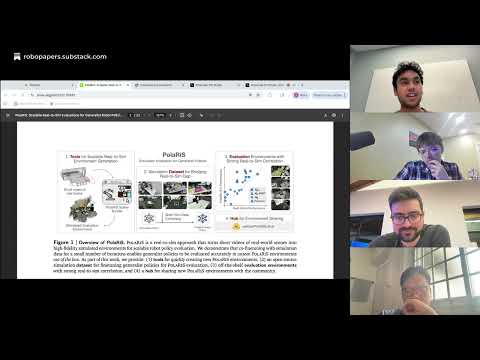
Adopt PolaRiS for rapid policy iteration. Leverage its real-to-sim environment generation and minimal sim data co-training to quickly validate robot policies in diverse, unseen environments before committing to expensive real-world deployments.
The era of generalist robot policies demands a new paradigm for evaluation. The shift is from bespoke, real-world testing to scalable, high-fidelity sim-to-real correlation, enabling faster iteration and broader generalization testing.
Reliable sim-to-real evaluation is the missing link for accelerating robot AI. PolaRiS offers a pragmatic, community-driven path to unlock faster development cycles and more robust generalist robot policies over the next 6-12 months.
Generalist robot policies demand evaluation that tests true generalization across diverse, unseen environments. The shift is from hand-tuned, task-specific benchmarks to scalable, community-driven evaluation suites that can keep pace with rapidly improving model capabilities. This requires tools that make environment creation cheap and ensure real-world predictive power.
Adopt PolaRiS for rapid, correlated policy iteration. Builders should leverage its real-to-sim environment generation (Gaussian splatting for scenes, generative models for objects) and the "sim co-training" trick to quickly validate policy improvements against real-world performance, especially for pick-and-place tasks. Contribute new environments to the Polaris Hub to expand the collective benchmark.
The future of robotics hinges on fast, reliable evaluation. PolaRiS offers a pragmatic, immediate solution to accelerate policy development by providing high-fidelity, correlated sim environments. Over the next 6-12 months, expect this hybrid approach to become a standard for iterating on generalist robot policies, while fully learned world models continue to improve for more complex, deformable tasks.
The push for generalist robot policies demands scalable, trustworthy evaluation. PolaRiS democratizes high-fidelity sim evaluation, moving robotics closer to rapid iteration cycles seen in other AI fields.
Builders should explore PolaRiS's open-source tools and pre-trained checkpoints to quickly test policies in diverse, real-world-correlated environments. Prioritize visual fidelity and use small, unrelated sim data for alignment.
Rapid, reliable sim evaluation with strong real-world correlation is a significant advancement. This tool enables faster policy iteration, broader generalization, and community-driven benchmarking, setting the stage for the next generation of robot capabilities.
Generalist robot policies demand community-driven, scalable evaluation, mirroring LLM benchmarking. PolaRiS provides the technical foundation by making high-fidelity, correlated sim environments accessible.
Adopt PolaRiS for rapid policy iteration. Use its browser-based scene builder and Gaussian splatting for quick environment creation, incorporating minimal, unrelated sim co-training data for strong real-world correlation.
PolaRiS accelerates robot development with a reliable, scalable simulation tool. This means faster iteration, more robust policies, and a clearer path to real-world deployment for your robot applications over the next 6-12 months.
The era of generalist robot policies demands evaluation tools that can keep pace with rapid development and broad generalization. PolaRiS pushes robotics toward the LLM benchmark paradigm, where models are tested on unseen environments and tasks, rather than being trained on specific benchmarks.
For builders, leverage PolaRiS's browser-based scene builder and Gaussian splatting pipeline to quickly create diverse, high-fidelity evaluation environments from real-world scans. This enables faster policy iteration and more reliable real-world deployment.
PolaRiS offers a pragmatic, scalable path to more effective robot policy development. By providing a tool that makes sim performance a reliable predictor of real-world success, it accelerates the journey from lab to real-world application, especially for pick-and-place tasks, and sets the stage for community-driven benchmarking.
Celebrity capital is evolving from passive endorsements to active, strategic equity investment, transforming athletes and entertainers into powerful venture partners who bring more than just money to the table.
Prioritize building a diverse, expert team that can challenge your assumptions and vet opportunities, especially when entering new sectors like AI or overlooked geographic markets.
Long-term thinking, a willingness to invest in growth, and a focus on strategic partnerships are non-negotiable for building lasting wealth and influence in both traditional and emerging industries over the next 6-12 months.
Institutional capital is increasingly seeking permissionless, global markets, but existing blockchain infrastructure struggles to meet this demand without compromising core decentralized values. Zero attempts to bridge this gap by delivering enterprise-grade throughput on a broadly decentralized network.
Evaluate Zero's technical papers (QMDB, FAFO, Zero OS) and upcoming mainnet launch. Builders should consider its multi-VM and Linux binary compatibility for deploying high-performance applications, especially in payments and global markets.
Zero represents a bold attempt to solve the blockchain scalability trilemma through fundamental architectural breakthroughs and strategic institutional partnerships. Its success could redefine what's possible for decentralized finance and global markets over the next 6-12 months, making it a critical project to monitor.
The industry is moving from a "build it and they will come" mentality to a highly intentional, ecosystem-first approach, recognizing that raw tech specs alone don't guarantee adoption. This is coupled with a critical legal battle to define developer liability, which will dictate the future of open-source crypto innovation.
Investigate projects that prioritize real-world utility and long-term ecosystem health over short-term token hype. For builders, focus on creating "10x" user experiences that justify new infrastructure, while understanding the evolving legal framework for non-custodial software.
The next 6-12 months will see a clearer delineation of regulatory boundaries for developers and a competitive race among high-performance chains to onboard institutional and consumer applications. Success hinges on a blend of technical superiority, strategic ecosystem cultivation, and legal clarity.
The US economy undergoes a "Great Reset" towards higher nominal growth, rates, and deficits, underpinned by surging gig economy tax collections and unprecedented AI capital expenditure, creating a disconnect with conventional sentiment.
Overweight international assets, particularly Latin America and Europe, to diversify from over-concentrated US equity.
The confluence of hidden nominal growth, aggressive fiscal policy, and AI-driven capex points to a sustained inflationary environment and asset price appreciation through 2026, challenging recessionary fears and demanding a re-evaluation of portfolio allocations.
The DeFi era is consolidating. Institutional RWA adoption will drive isolated, high-volume activity on private chains. LeiFi builds the connective tissue to bridge these environments.
Builders and investors should prioritize infrastructure that abstracts multi-chain complexity and provides robust distribution for tokenized assets. Investigate LeiFi's new checkout product and intent system.
Exponential fragmentation is crypto's reality for the next decade. LeiFi's meta-aggregation, virtual machine, and intent system are foundational rails for institutional capital and RWA liquidity.
Diversify stablecoin holdings beyond regulated fiat-backed options. Allocate a portion to decentralized, crypto-backed stablecoins to gain uncorrelated yield, mitigate counterparty risk, and preserve property rights, especially for crypto-native operations or users in restrictive jurisdictions.
The increasing weaponization of traditional finance and demand for censorship resistance is driving a technical reality: the need for truly sovereign, code-governed financial primitives. This pushes capital towards crypto-native stablecoins that offer an opt-out from traditional financial control.
Regulated stablecoins will become commoditized rails for traditional finance, while truly decentralized stablecoins will solidify their niche as the preferred choice for those prioritizing censorship resistance, self-custody, and organic DeFi yield. Understanding this bifurcation is crucial for positioning portfolios and building infrastructure that aligns with crypto's core ethos.
The real estate industry is undergoing a fundamental re-architecture, moving from centralized, opaque, and debt-heavy models to decentralized, transparent, and equity-driven tokenized platforms. This shift, powered by AI and blockchain, will redefine property access and wealth creation.
Investigate tokenization platforms that leverage AI for appraisal and inspection, particularly those offering yield-bearing real estate tokens. Consider strategies that use rental income to service interest on borrowed capital, effectively creating leveraged exposure to appreciating assets without traditional mortgage obligations.
The convergence of AI and tokenization is not just optimizing real estate; it is creating entirely new financial primitives. Understanding Resi's full-stack approach—intelligence, infrastructure, and financial services—is crucial for positioning yourself in a market that could soon offer "mortgages you don't pay back" and unlock unprecedented liquidity for property owners.