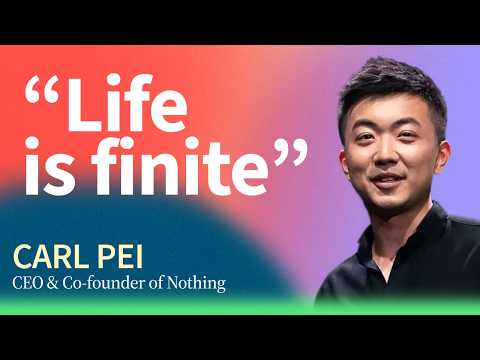
The Macro Shift: Infrastructure Invisibility. As core technologies become background noise, value moves from the pipes to the unique experiences built on top of them.
The Tactical Edge: Reject Mediocrity. Audit your product for average features and replace them with high-conviction improvements that competitors are too lazy to attempt.
The Bottom Line: Building is the only way to ensure the future happens. If you do not create the next version of reality, you are stuck living in an outdated vision.
The transition from hardware specs to emotional hardware where brand identity and OS-native AI become the primary moats.
Prioritize arbitrage opportunities in marketing by finding underpriced attention on platforms like TikTok before they become crowded.
Success in mature markets requires a Genghis Khan method: be a talent scout, stay open-minded to global supply chains, and use design to win the emotional battle for the consumer's pocket.
The transition from centralized cloud training to distributed local inference creates a massive demand for high-bandwidth storage and custom CPUs.
Audit your technical roadmap to prioritize local agentic workflows that reduce latency and data privacy risks.
The next 12 months will favor hardware that enables physical AI and local autonomy. Owning the compute stack is becoming a competitive necessity for builders who want to move faster than the cloud allows.
Intelligence is decoupling from scale. As reasoning becomes a commodity, the value moves from the size of the model to the proprietary nature of the training data.
Use TRL or Unsloth for single-GPU fine-tuning. Prioritize cleaning your instruction sets over increasing your training iterations.
The future belongs to those who own their data pipelines. If you can distill elite reasoning into a 350M parameter model, you win on latency, cost, and privacy.
Software maintenance is moving from a manual craft to an industrial process. As agents handle the toil of migrations and security, human engineers will focus entirely on high-level system design.
Batch by Dependency. Use the OpenHands SDK to visualize your codebase as a graph and deploy agents to solve the leaf nodes first.
Companies that master agent orchestration will clear their tech debt backlogs in weeks instead of years, creating a massive competitive advantage in product velocity.
Institutional capital is increasingly seeking permissionless, global markets, but existing blockchain infrastructure struggles to meet this demand without compromising core decentralized values. Zero attempts to bridge this gap by delivering enterprise-grade throughput on a broadly decentralized network.
Evaluate Zero's technical papers (QMDB, FAFO, Zero OS) and upcoming mainnet launch. Builders should consider its multi-VM and Linux binary compatibility for deploying high-performance applications, especially in payments and global markets.
Zero represents a bold attempt to solve the blockchain scalability trilemma through fundamental architectural breakthroughs and strategic institutional partnerships. Its success could redefine what's possible for decentralized finance and global markets over the next 6-12 months, making it a critical project to monitor.
The industry is moving from a "build it and they will come" mentality to a highly intentional, ecosystem-first approach, recognizing that raw tech specs alone don't guarantee adoption. This is coupled with a critical legal battle to define developer liability, which will dictate the future of open-source crypto innovation.
Investigate projects that prioritize real-world utility and long-term ecosystem health over short-term token hype. For builders, focus on creating "10x" user experiences that justify new infrastructure, while understanding the evolving legal framework for non-custodial software.
The next 6-12 months will see a clearer delineation of regulatory boundaries for developers and a competitive race among high-performance chains to onboard institutional and consumer applications. Success hinges on a blend of technical superiority, strategic ecosystem cultivation, and legal clarity.
The US economy undergoes a "Great Reset" towards higher nominal growth, rates, and deficits, underpinned by surging gig economy tax collections and unprecedented AI capital expenditure, creating a disconnect with conventional sentiment.
Overweight international assets, particularly Latin America and Europe, to diversify from over-concentrated US equity.
The confluence of hidden nominal growth, aggressive fiscal policy, and AI-driven capex points to a sustained inflationary environment and asset price appreciation through 2026, challenging recessionary fears and demanding a re-evaluation of portfolio allocations.
The DeFi era is consolidating. Institutional RWA adoption will drive isolated, high-volume activity on private chains. LeiFi builds the connective tissue to bridge these environments.
Builders and investors should prioritize infrastructure that abstracts multi-chain complexity and provides robust distribution for tokenized assets. Investigate LeiFi's new checkout product and intent system.
Exponential fragmentation is crypto's reality for the next decade. LeiFi's meta-aggregation, virtual machine, and intent system are foundational rails for institutional capital and RWA liquidity.
Diversify stablecoin holdings beyond regulated fiat-backed options. Allocate a portion to decentralized, crypto-backed stablecoins to gain uncorrelated yield, mitigate counterparty risk, and preserve property rights, especially for crypto-native operations or users in restrictive jurisdictions.
The increasing weaponization of traditional finance and demand for censorship resistance is driving a technical reality: the need for truly sovereign, code-governed financial primitives. This pushes capital towards crypto-native stablecoins that offer an opt-out from traditional financial control.
Regulated stablecoins will become commoditized rails for traditional finance, while truly decentralized stablecoins will solidify their niche as the preferred choice for those prioritizing censorship resistance, self-custody, and organic DeFi yield. Understanding this bifurcation is crucial for positioning portfolios and building infrastructure that aligns with crypto's core ethos.
The real estate industry is undergoing a fundamental re-architecture, moving from centralized, opaque, and debt-heavy models to decentralized, transparent, and equity-driven tokenized platforms. This shift, powered by AI and blockchain, will redefine property access and wealth creation.
Investigate tokenization platforms that leverage AI for appraisal and inspection, particularly those offering yield-bearing real estate tokens. Consider strategies that use rental income to service interest on borrowed capital, effectively creating leveraged exposure to appreciating assets without traditional mortgage obligations.
The convergence of AI and tokenization is not just optimizing real estate; it is creating entirely new financial primitives. Understanding Resi's full-stack approach—intelligence, infrastructure, and financial services—is crucial for positioning yourself in a market that could soon offer "mortgages you don't pay back" and unlock unprecedented liquidity for property owners.